


July 29, 2026 Wired vs Wireless Intraoral Cameras: An Honest Intraoral Camera Comparison
Few instruments do more quiet persuasion than the intraoral camera. A single crisp frame of a fractured cusp or a leaking margin accomplishes what minutes of explanation cannot, and it does so with a directness the patient trusts. Yet the moment you decide to buy one, the market splits down a single seam: wired or wireless. It is tempting to treat this as a question of old versus new. It is not. It is a question of how your operatories actually move, how your images are used, and where you are willing to trade convenience for control. What follows is an honest intraoral camera comparison, framed the way a clinician should frame it, so the wired vs wireless choice fits your practice rather than someone’s marketing.
Image quality and sensor resolution
Start where it matters most: the picture. On paper, wired and wireless cameras now share similar sensor classes, and both can deliver the high-resolution, well-lit frames that make pathology legible. The meaningful difference is what happens after the sensor. A wired camera sends its signal down a copper line as raw or lightly processed data, preserving fine tonal gradation and edge detail. Many wireless cameras must compress the stream before it travels over the air, and compression, however sophisticated, is a negotiation with fidelity. For routine patient education, that negotiation is invisible. For documentation you intend to enlarge, color-match, or scrutinize for a hairline crack, the wired path still holds a subtle but real advantage in image integrity.
Latency and lag: the wired vs wireless divide
Nothing exposes the difference between these two designs like motion. A wired camera renders to the monitor with near-zero latency; what your hand does, the screen shows in the same breath. That immediacy is not a luxury when you are hunting for a specific frame in a tight posterior field, angling around a tongue and a mirror to freeze the one image that tells the story. Wireless cameras introduce a delay, sometimes only a few dozen milliseconds, sometimes enough to feel like the screen is chasing your hand. Modern proprietary radio links have narrowed this gap impressively, but Wi-Fi and Bluetooth transports remain the most prone to visible lag, especially in operatories saturated with other signals. If capture speed and precision framing define your work, latency is the line item that should weigh heaviest.
Connectivity and reliability
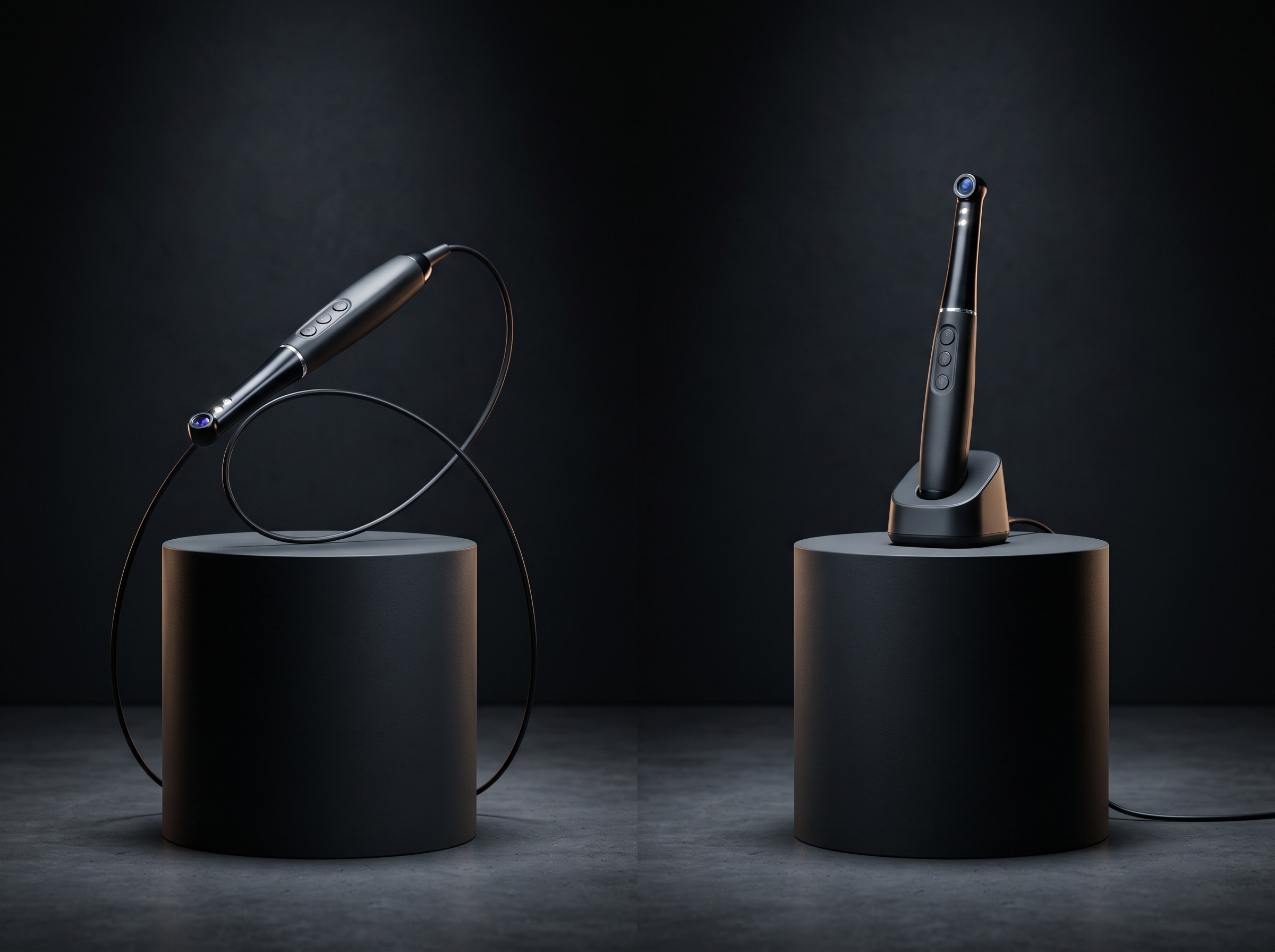
A cable is a humble thing, and it is also the most reliable connection in the room. USB draws power and carries data in one movement, with no pairing, no channel congestion, and no dropped frames. Its weakness is equally plain: cables strain, kink, and eventually fail at the flex points, and they tether the operator to one workstation. Wireless designs remove the leash but inherit the complexity of the radio. Proprietary RF dongles tend to be the most dependable of the cordless options, purpose-built for low-latency video. Wi-Fi cameras offer flexibility but compete with every other device on the network. Bluetooth is the most convenient and the least suited to sustained high-resolution video. The honest summary: wired is reliable by default, while wireless is reliable only to the degree that its transport and your environment cooperate.
Battery life, charging, and infection control

A wired camera never needs charging; it feeds from the port and is always ready. A wireless camera lives on a schedule of charge cycles, and a dead battery mid-session is a failure mode wired users never contemplate. Practices that adopt cordless units learn to build docking into their between-patient rhythm, and battery health becomes a maintenance concern that degrades over years of use.

Infection control cuts across both designs and deserves real attention. Both wired and wireless cameras rely on disposable barrier sheaths over the handpiece and tip, changed for every patient, backed by surface disinfection of the body between uses. The cable itself is another surface to wipe down and a potential vector if neglected. Wireless removes that length of cable from the equation, which some clinicians find genuinely easier to keep clean, but the charging cradle then becomes its own touch surface to manage. Neither design excuses you from protocol; each simply shifts where your diligence is directed.
Software integration, portability, and total cost of ownership
Even a flawless image is worthless if it does not land cleanly in the chart. Wired cameras, being long established, tend to enjoy mature, plug-and-play integration with imaging platforms and practice management systems, often capturing directly into the patient record with a footswitch or button. Wireless cameras can integrate just as smoothly, but the bridge software and drivers are more numerous and occasionally more fragile; confirm compatibility with your specific PMS before you commit. Portability is the wireless camera’s home ground: a single cordless unit can drift from operatory to operatory and follow a hygienist who works across chairs, where a wired setup generally implies a dedicated camera per room. That mobility is also where the money conversation turns. A wired camera has a lower sticker price and fewer failure points, but a per-operatory rollout multiplies that cost. A single shared wireless unit can cover several rooms for less, though batteries, chargers, and integration overhead quietly raise its total cost of ownership over the years. Count the whole system, not the handpiece.
A decision framework
Reduced to essentials, the choice resolves cleanly. Wired wins when image fidelity is paramount and volume is high in a fixed setting: a busy single operatory, a documentation-heavy workflow, an office that enlarges and archives images for medico-legal or laboratory precision. The near-zero latency, uncompromised picture, and set-and-forget reliability reward practices that capture constantly in one place. Wireless wins when movement is the priority: multi-operatory offices that share one camera, hygienists who rove between chairs, and clinicians who value the patient comfort of an untethered instrument that never drags a cable across a shoulder. If your bottleneck is flexibility and sharing, cordless earns its premium. If your bottleneck is precision and uptime, the cable earns its keep. Many mature practices land on a deliberate hybrid: wired workhorses in the highest-volume rooms, a wireless unit floating to cover the rest.
Future developments
The seam between wired and wireless is narrowing, and the next few years will blur it further. AI-assisted capture is arriving first, with on-device models that auto-detect the ideal frame, flag suspected caries or cracks in real time, and stabilize and label images before they reach the chart, reducing the manual hunt that today rewards low latency. Sensor technology continues its climb toward higher resolution, better low-light performance, and richer color accuracy, tightening the fidelity gap that currently favors wired transports. On the connectivity side, emerging wireless standards built for high-bandwidth, low-latency video, alongside more efficient onboard compression, promise cordless capture that finally feels indistinguishable from a cable. As batteries grow denser and charging grows faster, the practical penalties of going wireless will keep shrinking. The instrument is becoming quieter, smarter, and less encumbered, but the discipline behind it is unchanged: choose the tool that matches how your practice actually works, and let the image do its patient, persuasive work.
Sorry, the comment form is closed at this time.