


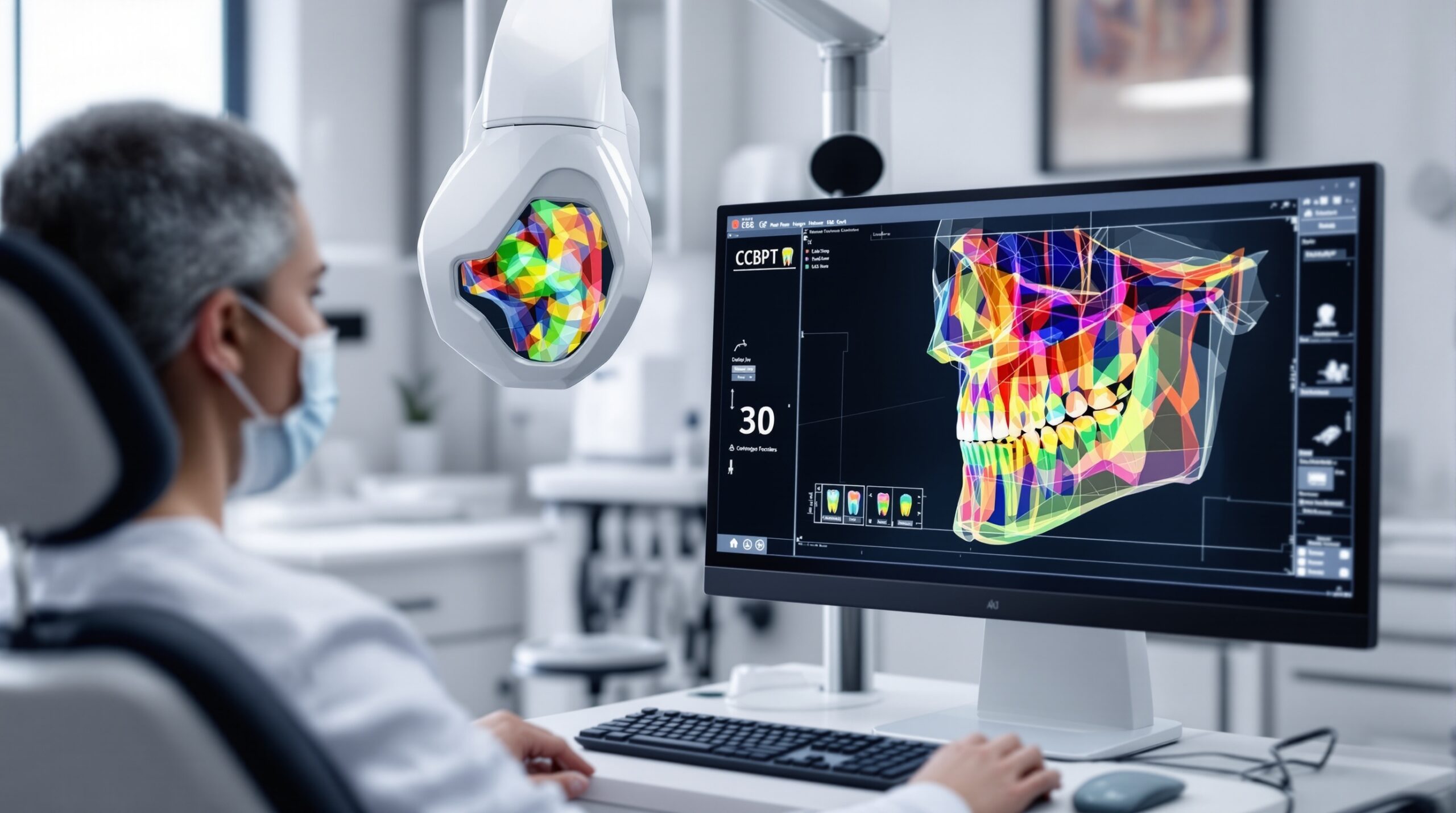
17 Feb AI-Powered CBCT Analysis: Revolutionizing Dental Diagnosis
Cone Beam Computed Tomography (CBCT) has already transformed dental imaging, providing three-dimensional views of oral structures that were impossible with traditional radiography. Now, the integration of artificial intelligence into CBCT analysis is taking this revolution one step further, enabling faster diagnoses, improved treatment planning, and enhanced patient outcomes.
The Evolution of CBCT Technology
Since its introduction to dentistry in the late 1990s, CBCT has become an essential tool for oral surgeons, orthodontists, and general practitioners. Unlike traditional two-dimensional X-rays, CBCT captures volumetric data that reveals the spatial relationships between teeth, bone, nerves, and surrounding structures. However, interpreting these complex 3D datasets requires specialized training and can be time-consuming.
The addition of AI algorithms to CBCT workflows addresses these challenges by automating many aspects of image analysis. Machine learning models can identify anatomical landmarks, detect pathology, and even suggest treatment approaches based on thousands of previously analyzed cases.
How AI Enhances CBCT Analysis
Automated Landmark Detection
One of the most significant advantages of AI-powered CBCT analysis is the automatic identification of critical anatomical landmarks. Traditional manual analysis requires practitioners to carefully identify structures such as:
- Inferior alveolar nerve canal
- Maxillary sinuses
- Temporomandibular joint components
- Root apices and canal configurations
- Bone density variations
AI algorithms can locate these structures within seconds, providing consistent and reproducible measurements that serve as the foundation for accurate treatment planning.
Pathology Detection and Classification
Advanced machine learning models excel at pattern recognition, making them particularly valuable for identifying pathological conditions that might be subtle or easily overlooked. AI systems can detect:
- Periapical lesions and their extent
- Bone loss patterns indicating periodontal disease
- Impacted teeth positioning and potential complications
- TMJ abnormalities and degenerative changes
- Airway obstructions and sleep apnea indicators
The AI analysis provides confidence scores for each detection, allowing clinicians to focus their attention on areas that require further evaluation.
Clinical Applications and Benefits
Implant Planning Precision
Dental implant placement requires precise understanding of bone quality, quantity, and anatomical limitations. AI-powered CBCT analysis can automatically assess bone density throughout the jaw, identify optimal implant positions, and flag potential complications before surgery begins. This reduces treatment time and improves success rates.
Orthodontic Treatment Planning
For orthodontists, AI analysis of CBCT data provides detailed information about root positions, bone thickness, and tooth movement limitations. The technology can simulate various treatment approaches and predict outcomes, helping practitioners choose the most effective treatment strategy for each patient.
Endodontic Assessment
Root canal treatment success depends heavily on understanding complex canal anatomy. AI algorithms can trace canal systems throughout the root structure, identify calcifications, and predict the likelihood of treatment success. This information is invaluable for determining whether endodontic therapy is feasible or if extraction and replacement is more appropriate.
Implementation Considerations
Training and Workflow Integration
Successfully implementing AI-powered CBCT analysis requires careful consideration of staff training and workflow modifications. While the technology is designed to be intuitive, practitioners must understand both its capabilities and limitations. Regular calibration and validation against known cases ensures accuracy and builds confidence in the system’s recommendations.
Quality Assurance and Validation
AI systems are only as good as the data they’re trained on, and maintaining quality assurance protocols is essential. Regular validation against expert interpretations helps identify potential biases or errors in the AI analysis. Many systems also provide uncertainty measures that indicate when human review is particularly important.
Future Developments
Multi-Modal Integration
The next generation of AI-powered dental imaging will integrate CBCT data with other imaging modalities, including intraoral photographs, digital impressions, and even patient-reported symptoms. This comprehensive approach will provide an even more complete picture of oral health status and treatment needs.
Predictive Analytics
Beyond current diagnostic capabilities, AI systems are being developed to predict disease progression and treatment outcomes. By analyzing patterns in large datasets, these tools will help practitioners anticipate future problems and implement preventive strategies.
Patient Communication and Education
AI-generated visualizations and reports can significantly enhance patient communication. Complex 3D anatomical relationships can be simplified into understandable visual presentations that help patients comprehend their condition and proposed treatments. This improved communication leads to better treatment acceptance and compliance.
Cost-Effectiveness and Accessibility
While the initial investment in AI-powered CBCT systems may be substantial, the long-term benefits include reduced interpretation time, fewer diagnostic errors, and improved treatment outcomes. As the technology matures and becomes more widespread, costs are expected to decrease, making advanced diagnostic capabilities accessible to a broader range of practices.
Conclusion
AI-powered CBCT analysis represents a significant advancement in dental diagnostics, offering unprecedented accuracy, speed, and consistency in image interpretation. As these technologies continue to evolve, they will undoubtedly play an increasingly important role in comprehensive patient care, treatment planning, and clinical decision-making.
For dental practitioners considering this technology, the key is to view AI as a powerful diagnostic aid rather than a replacement for clinical expertise. The most successful implementations combine the pattern recognition capabilities of AI with the clinical judgment and experience of skilled practitioners, creating a synergy that benefits both doctors and patients.
The future of dental imaging is clearly moving toward intelligent, AI-assisted diagnosis. Practices that embrace these technologies today will be well-positioned to provide superior patient care while maintaining competitive advantages in an increasingly sophisticated healthcare environment.
Sorry, the comment form is closed at this time.