


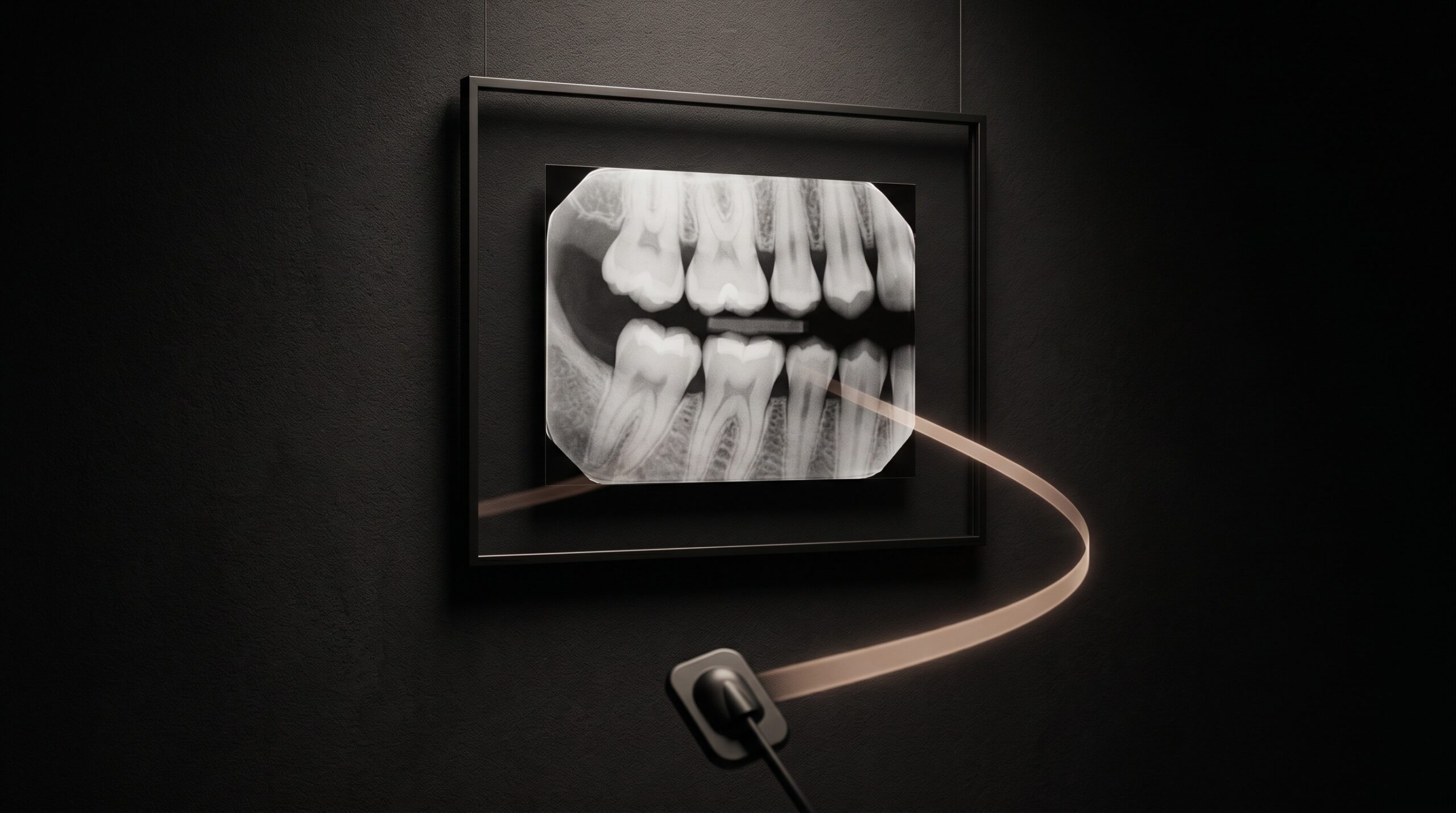
August 27, 2026 VideaHealth and TWAIN: How Imaging Software Feeds the AI
Every automated reading begins with a quiet act of trust: the imaging software has to be willing to let go of the picture. VideaHealth is one of the most decorated names in dental artificial intelligence – a caries-and-disease detector cleared to lay a second reading over the radiograph the clinician just captured. But the detections, impressive as they are, are downstream of a far more mundane question. How does the freshly exposed image actually get from the sensor into the AI? For an enormous number of practices, the unglamorous answer is a decades-old standard called TWAIN, and understanding it explains more about who can use this technology than any accuracy statistic ever will.
What VideaHealth Is Cleared to See
It is worth stating VideaHealth’s regulatory footprint precisely, because in a field prone to hand-waving, precision is the whole point. In 2022, the FDA granted 510(k) clearance to Videa Caries Assist, an algorithm that detects dental caries – cavities – on intraoral radiographs. That was the opening move. In early 2024 the company announced a substantially broader clearance for its Videa Dental Assist platform, described as encompassing more than thirty AI algorithms and extending detection across the most common dental diseases rather than caries alone. The through-line is consistency: the model does not fatigue on the fortieth bitewing of the afternoon, and it does not let the eye slide past the corner of the film.
The honest framing, and the one the clearances themselves demand, is that this is software cleared to assist. It surfaces suspected findings for a clinician to confirm or dismiss; it does not diagnose on its own. We will not print specific 510(k) numbers here, because clearance identifiers are exactly the sort of detail that should be checked against the FDA’s public database rather than trusted to a press summary. What matters for imaging is simpler: VideaHealth reads the radiograph, and to read it, it first has to receive it.
TWAIN: The Handshake Older Than the AI
TWAIN is one of those foundational standards most clinicians have used their whole careers without naming. Born in the early 1990s to let any piece of software ask any scanner or capture device for an image, it became the universal handshake between an imaging program and the hardware that produces pictures. In a dental operatory, TWAIN is frequently the mechanism by which the imaging software tells the intraoral sensor, panoramic unit, or scanner, “give me the frame you just took” – and receives it in a form it can display and store.
That makes TWAIN a natural on-ramp for AI. If a practice’s imaging stack acquires its radiographs through a TWAIN driver, then the same moment-of-capture handshake that hands the image to the viewer can, in principle, hand a copy to VideaHealth. The AI does not need to reinvent acquisition; it can ride the standard the operatory already uses. Industry integration write-ups describe exactly this: because VideaHealth supports TWAIN acquisition, a practice whose imaging software speaks TWAIN has a direct pathway to feed the AI, even where no bespoke bridge to that specific software has been built.
The Round Trip You Do Not See
Here is the detail imaging people should sit with, because it is where the marketing goes quiet: VideaHealth’s analysis happens in the cloud. The radiograph does not simply get scored on the operatory PC and forgotten. It is transmitted to VideaHealth’s infrastructure, evaluated by the models, and the annotations are returned for display over the original image. Nothing about the intelligence occurs until the picture has successfully left the building and come back.
That round trip elevates the acquisition-and-transport layer from a footnote to a precondition. TWAIN, or a direct software integration, is what gets the image out the door in the first place; a secure connection carries it to the cloud and returns the findings; and the imaging viewer has to reunite those findings with the correct study so the clinician sees rings and outlines on the right tooth. Every one of those steps is plumbing, and every one of them can be the reason a practice either has seamless AI or has nothing at all. It is the same infrastructural truth we traced through a different vendor in Pearl on the Radiograph: the image is only as useful as its ability to travel.
The Other Road: Embedded Partner Integrations
TWAIN is the universal fallback, but it is not the only way VideaHealth reaches the chair, and often not the smoothest. The company has also embedded itself directly inside major imaging and practice-management platforms, where the handoff is invisible to the user. The most prominent example is Dentrix, where the AI ships as “Detect AI, powered by VideaHealth,” wired straight into the practice-management and imaging workflow so that radiographs are analyzed as part of normal charting rather than through a separate step. Cloud imaging platforms have done the same: SOTA Cloud, for instance, embeds VideaHealth (alongside other engines) so findings appear inside the viewer the practice already lives in.
The distinction between these two roads is not academic. An embedded partner integration is a broad, native channel – the image is handed over automatically, in context, with patient data intact, and the reading returns to the same window. A TWAIN pathway is more universal but more manual in feel: it leans on the acquisition standard the practice already has, which is a gift for software that isn’t on any partner list, but it can add a step compared with a purpose-built bridge. Which experience a practice gets depends less on VideaHealth’s cleverness and more on whether their imaging platform is a named partner or simply a competent TWAIN citizen.
Why the Pipe Decides Who Gets the AI
For anyone building or choosing dental imaging software, this reframes the entire “adding AI” conversation. The detection engines are converging – VideaHealth, Pearl, and others now flag broadly similar rosters of findings with separately cleared, broadly comparable competence. The real differentiator has quietly become the send-out: can a platform get its acquired radiographs to a given AI at all, and return the reading without dragging the clinician out of their workflow? A platform that acquires cleanly through TWAIN, or exports clean DICOM, is already most of the way to any AI that consumes those standards. A platform locked into a proprietary capture format faces a bespoke bridge-building project for every vendor it wants to reach.
This is precisely why the integration method is worth cataloguing tool by tool rather than assuming they are interchangeable. VideaHealth’s TWAIN support and its Dentrix and cloud-platform partnerships describe a specific reachability profile – one that favours practices already on a partner platform, and still leaves a door open, via TWAIN, for those who are not. For the consumer-facing view of what this same tool does at the chairside, our companion piece VideaHealth: The AI That Charts Your Teeth Automatically covers the experience in plain language; this article is about the conduit beneath it.
Future Developments
The trajectory of detection is easy to predict: more conditions, tighter localization, and steady movement from flat film toward the volumetric depth of CBCT. The more interesting frontier, as ever, is access. As cleared reading becomes something close to a commodity, the deciding question stops being can the model see the caries and becomes how effortlessly can the picture reach it. The likely winners are the imaging platforms fluent in the standards that already move images – TWAIN at the moment of capture, DICOM for everything that follows – and disciplined enough to bring the annotation home to the exact frame the clinician was studying. The radiograph has always been a made thing, a small piece of craft. What the AI era adds is a second craft laid over the first: the quiet, unshowy art of the handoff, the pipe that carries the picture out and brings the reading back.
Sources & further reading:
- VideaHealth Dental AI Solution Receives FDA 510(k) Clearance (Videa Caries Assist) – Business Wire
- Videa Receives FDA Clearance for Comprehensive Dental AI Platform (Videa Dental Assist)
- Dentrix – Detect AI, powered by VideaHealth (imaging integration)
Sorry, the comment form is closed at this time.