


November 20, 2026 Full Frame or Crop? What the Sensor Really Changes in the Clinical Dental Photograph
Walk any dental trade floor and the hierarchy seems settled: the full-frame camera sits at the top, larger and heavier and several times the price, and the assumption travels with it that the bigger sensor must make the better clinical photograph. It is an intuition borrowed wholesale from landscape and wedding photography, where a large sensor genuinely transforms the image. Carried into the operatory, where every exposure is a flash-lit, stopped-down macro of a few square centimetres of enamel, that intuition quietly stops being true. The honest question is not which sensor is grander but which variables actually move the clinical result — and the sensor’s format turns out to be one of the smaller levers in the room.
To see why, it helps to set aside the marketing and look at what a sensor format really is: a rectangle of a particular size that samples the image a lens projects. A full-frame sensor measures about 36 by 24 millimetres; an APS-C “crop” sensor is roughly two-thirds of that in each dimension; Micro Four Thirds is smaller still. Everything that follows — field of view, depth of field, the behaviour of the aperture — flows from that single difference in how much of the projected image the rectangle catches.
Magnification is the measurement, not the megapixels
Clinical photography is, at heart, a measuring discipline. The value of a retracted frontal view or an occlusal mirror shot comes from its being made at a known, repeatable reproduction ratio — 1:1, 1:2, 1:10 — so that today’s image can be laid honestly beside one taken two years ago. That ratio is a property of the lens relative to the sensor plane, not of the sensor’s size. Set a macro lens to 1:2 and it projects the tooth at half life-size onto the sensor regardless of which body is behind it.
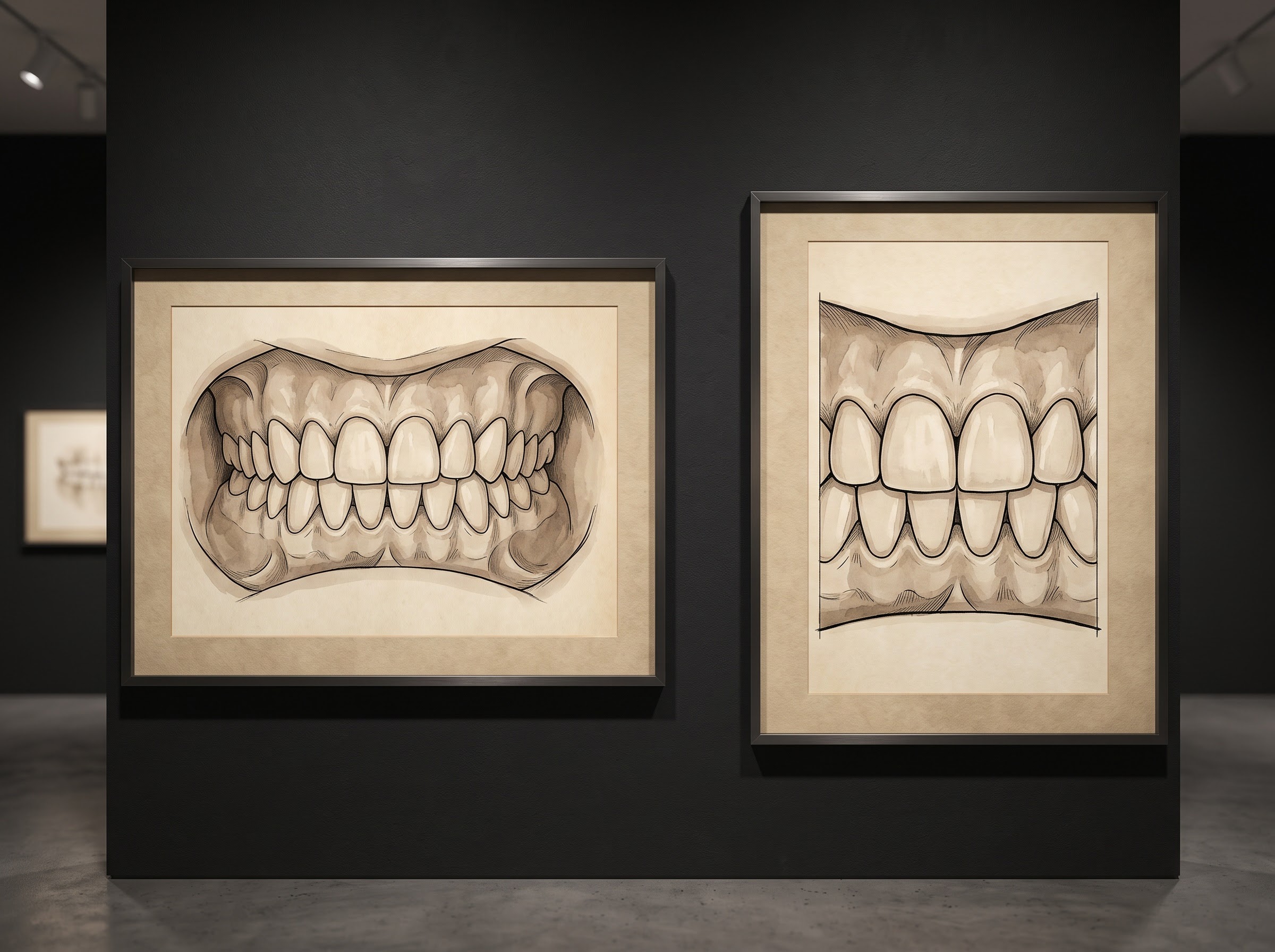
What the format changes is how much surrounding field that fixed ratio captures. A smaller sensor, catching less of the projected circle, frames more tightly around the same teeth — the familiar “crop factor” effect. In practice this means a crop body reaches a given clinical framing at a lower magnification on the sensor, or gives you tighter reach from the same lens, while the standardised ratio you record and repeat is unchanged. The same discipline that governs whether a smartphone can hold dimensional fidelity in the esthetic zone applies here: fix the reproduction ratio first, and the format becomes a question of framing convenience rather than measurement accuracy.
The depth-of-field advantage hiding in the smaller sensor
Depth of field is the perennial shortage of intraoral macro. The arch curves away from the lens, the incisal edges and the distal surfaces lie on different planes, and at high magnification the zone of acceptable sharpness can shrink to a millimetre or two. Here the smaller sensor delivers a genuine, counter-intuitive gift: for the same framing of the same teeth at the same f-number, a crop or Micro Four Thirds body renders more depth of field than full frame, because it reaches that framing at a shorter focal length or a lower sensor-plane magnification. The format that costs less also, in this one decisive respect, gives the clinician more.
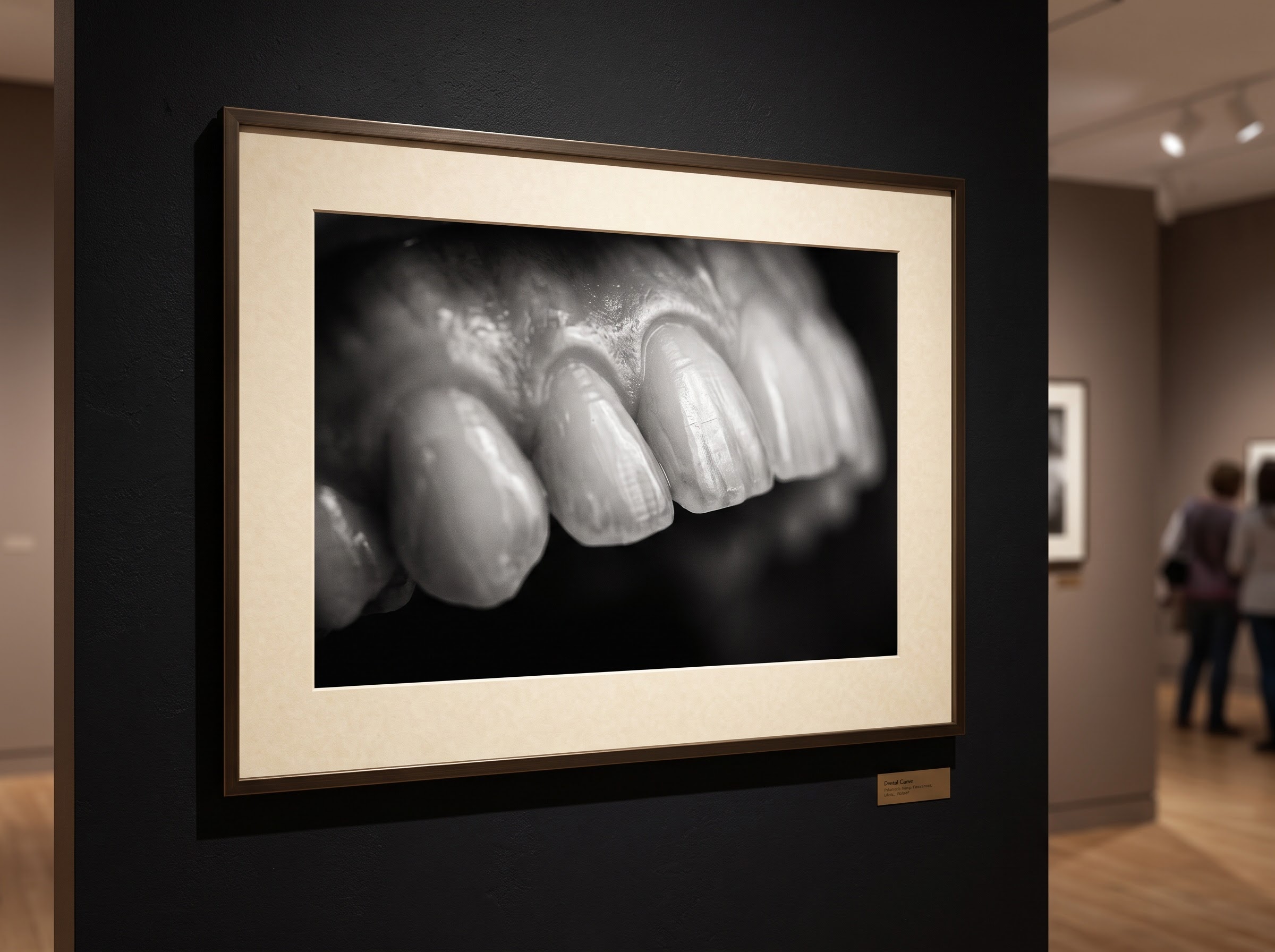
This is not a marginal laboratory curiosity. It is the difference between an anterior series in which both the labial surface and the incisal edge sit cleanly within focus and one in which the photographer must choose. It pairs naturally with the compositional care described in composing the retracted clinical portrait: a format that is more forgiving of the curved subject frees attention for midline, angulation and symmetry rather than for rescuing the plane of focus.
Where the trade-off bites: effective aperture and diffraction
No advantage in optics comes free. The same stopping-down that buys depth of field eventually surrenders sharpness to diffraction, and at macro distances the effect is amplified because the effective aperture widens with magnification — the working f-number is the marked value multiplied by one plus the magnification. Smaller sensors, with their smaller photosites, begin to show diffraction softening at wider apertures than full frame does. So the crop body that handed you extra depth of field also reaches its diffraction limit a little sooner, narrowing the usable aperture window.
In the clinic this is a manageable tension rather than a defeat. Dental macro rarely needs the extreme apertures where diffraction turns punishing, and the depth-of-field margin a smaller format grants usually outweighs the modest early softening. The lesson is not that one format wins but that each sensor has a slightly different sweet spot in the aperture range — a spot worth finding deliberately rather than inheriting from a landscape photographer’s habits.
Color, dynamic range, and the honest limits of format
The strongest argument for full frame is tonal: larger photosites gather more light, widening dynamic range and improving the rendering of subtle gradients — precisely the qualities that matter when a difficult shade must be captured faithfully or when wet enamel throws specular highlights that threaten to clip. That advantage is real. But it is also substantially neutralised by the way clinical photographs are actually made. The intraoral series is lit by a controlled ring or twin flash at base ISO, the one regime in which sensor format matters least; the high-ISO latitude that distinguishes full frame in dim rooms never comes into play. Where dynamic range still earns its keep is in demanding esthetic and shade work, the same territory covered by bracketing exposures to tame the highlight on wet enamel — and there a larger sensor can genuinely help. For the routine record, controlled light closes most of the gap the specification sheet promises.
The variables the format cannot touch
Step back and the ranking inverts. The reproducibility of a magnification series, the quality and consistency of the flash lighting, correct white balance, a clean macro lens, and the operator’s discipline in repeating the same views the same way — these govern whether a photograph serves diagnosis, communication and the medico-legal record. None of them is a function of sensor size. A standardised series shot on a modest crop body will out-document an inconsistent series shot on the costliest full-frame camera made, every time. When choosing a body at all is the question, the practical decision is better framed around ergonomics, flash compatibility and the lens system, as in selecting a mirrorless body for the operatory, than around the format badge.
There are, to be fair, places where full frame is the right instrument: portfolio portraiture with its shallow, flattering backgrounds; large exhibition prints; marketing imagery; and the subset of shade-critical cases where every stop of dynamic range counts. A practice that does serious esthetic documentation and patient-facing imagery may well justify it. But the dentist who buys full frame believing the daily clinical series demands it has, in most cases, paid a premium for capability the standardised macro record never calls upon — and has accepted more weight and less depth of field in the bargain.
Future Developments
The trajectory of imaging technology is steadily eroding what little the larger format still monopolises. Computational focus stacking is migrating into camera bodies and flashes, promising the deep, edge-to-edge sharpness the curved arch demands without forcing the diffraction trade-off onto any single frame. Sensor fabrication continues to narrow the dynamic-range gap between formats, and flash systems with better color consistency are closing the tonal distance that once favored the big sensor. As those advances arrive, the clinical argument will tilt further toward the smaller, lighter, more affordable body — and the enduring truth will stand out more plainly than ever: in the gallery of the clinical record, the image is made by the discipline of the hand and the honesty of the light, and only distantly by the size of the rectangle that happens to catch it.
Sources & further reading:
No Comments