


October 1, 2026 The Highlight That Burns White: HDR, Exposure Bracketing, and the Craft of Photographing Wet Enamel
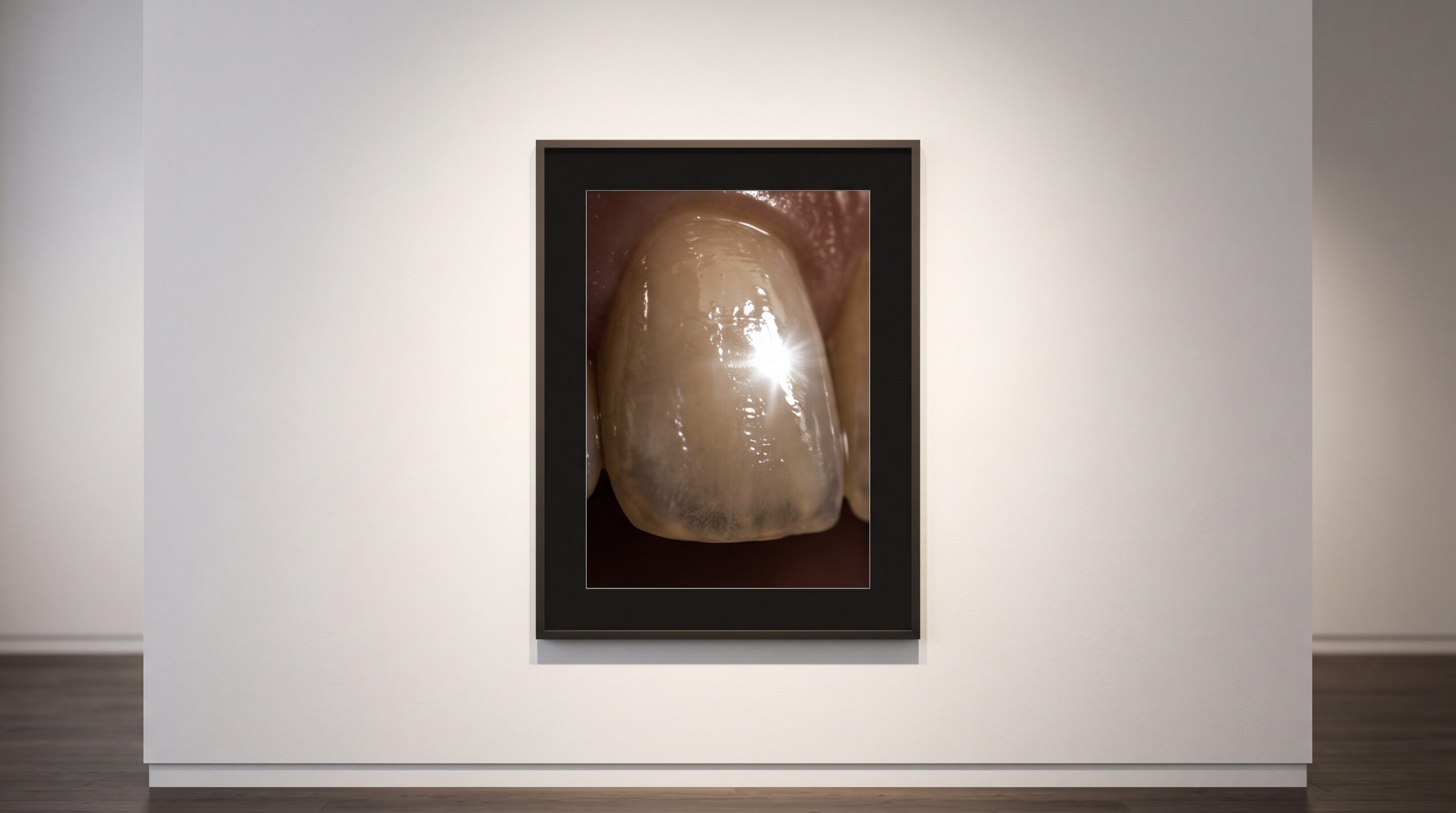
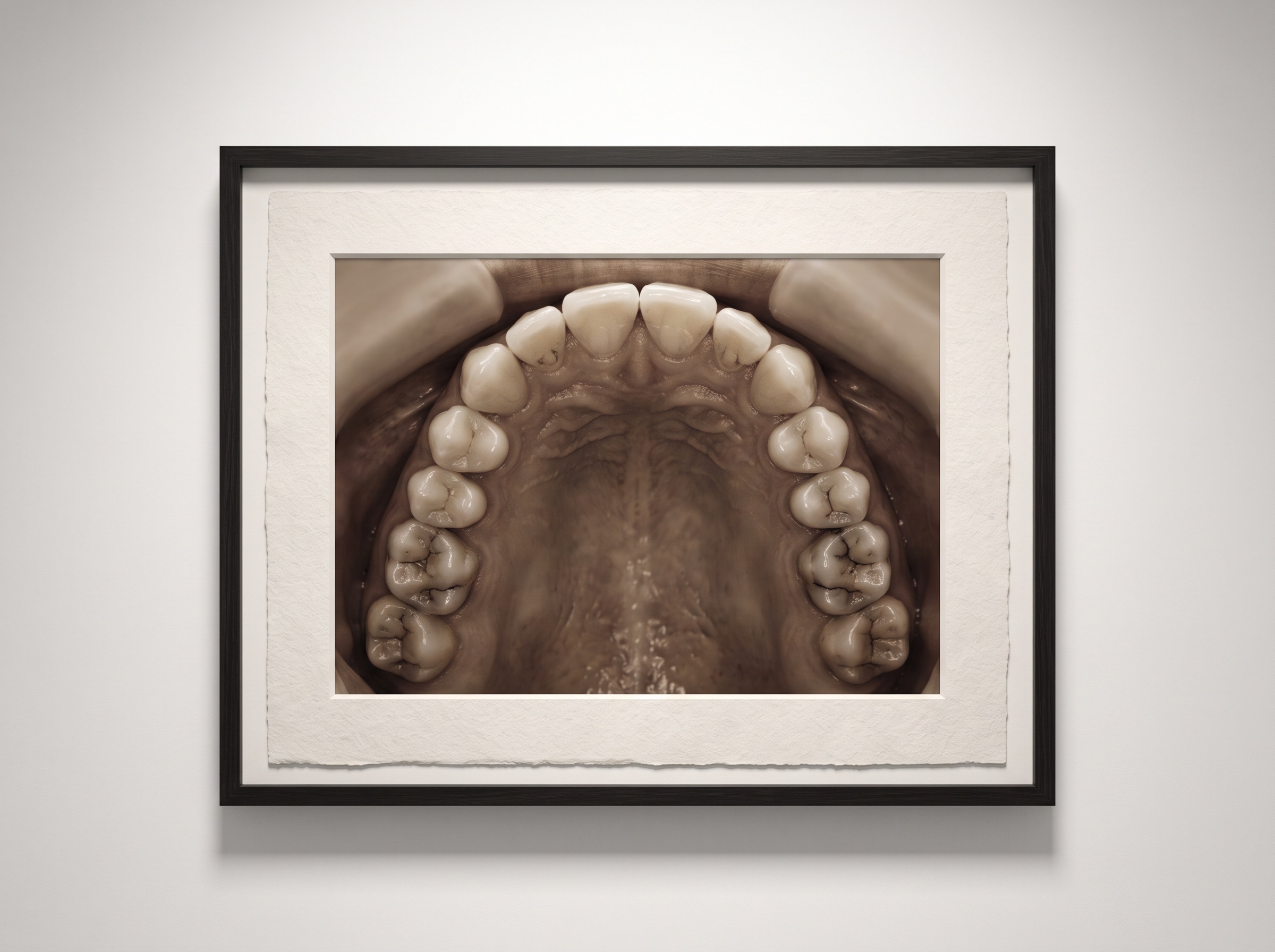
There is a moment every clinical photographer knows: the shot looks perfect through the viewfinder, the flash fires, and on review the most beautiful part of the tooth — the wet, gleaming incisal third — has vanished into a patch of featureless white. The detail is not dim. It is gone, clipped to pure paper, unrecoverable. At the same instant, the molars at the back of the arch have sunk into a shadow the eye never noticed. The mouth, it turns out, is one of the most punishing subjects in all of photography, and the reason is a single unforgiving quantity: dynamic range.
The Range the Mouth Demands
Dynamic range is the distance, measured in stops of light, between the brightest tone a scene contains and the darkest. Polished enamel coated in saliva behaves like a wet mirror; where it catches the flash it returns a specular highlight that can be hundreds of times brighter than the matte gingiva beside it, and brighter still than the recessed posterior teeth the retractor has pulled into view. A modern camera sensor captures perhaps twelve to fourteen stops in a single frame. A smile under twin flashes routinely asks for more. Something has to give — and by default it is the highlight that burns out or the shadow that blocks up, because no single exposure can straddle the whole span. The art of the clinical frame has always been, quietly, the art of choosing what to lose.
Bracketing: Refusing to Choose
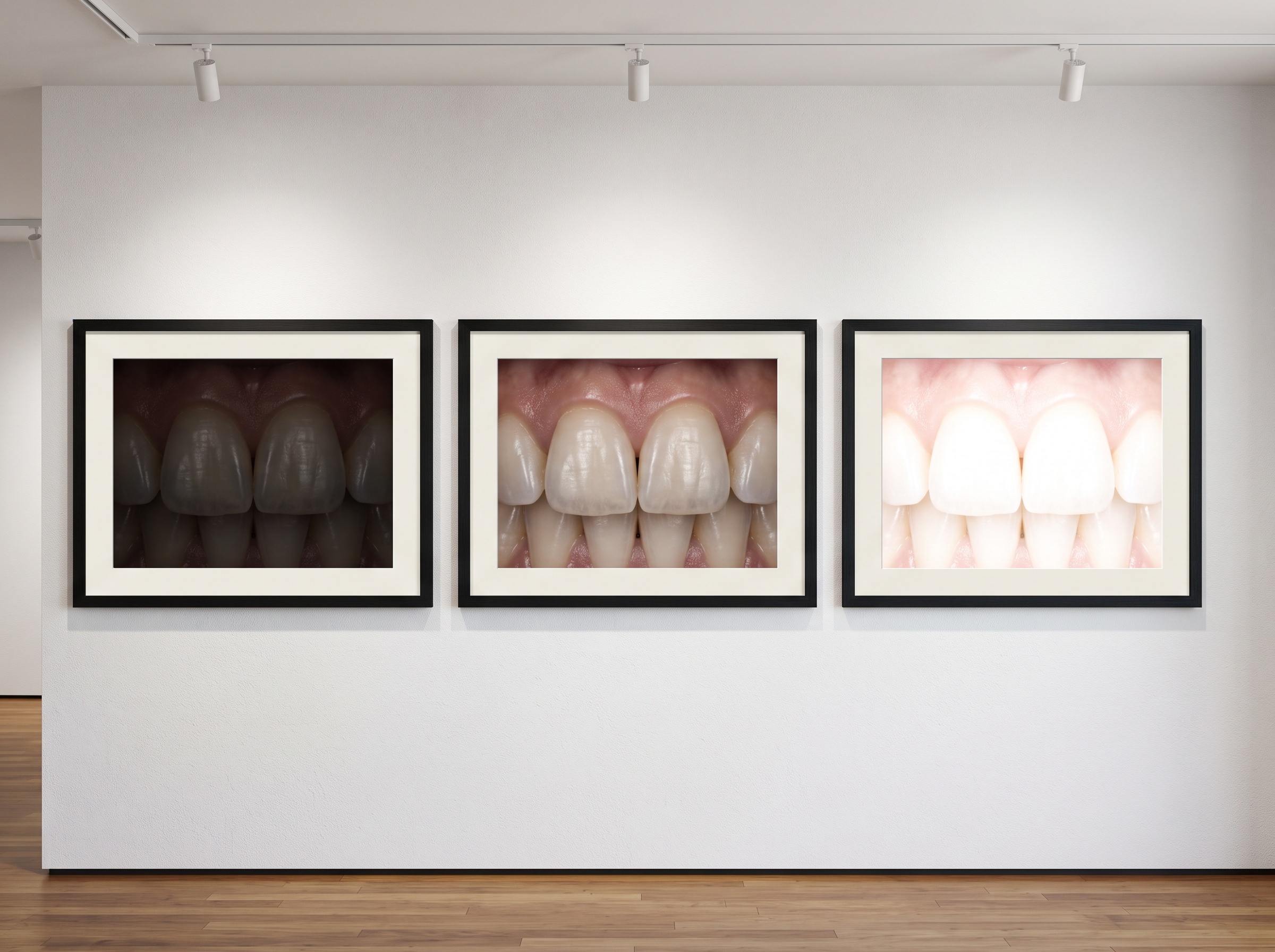
Exposure bracketing is the refusal to make that sacrifice in a single frame. Instead of one compromise, you capture a deliberate sequence — one exposure metered to protect the highlights, letting the shadows fall dark; one balanced for the midtones; one opened up to rescue detail from the deepest recesses. Each frame is honest about a different slice of the tonal range. Merged in software, the sequence becomes a high-dynamic-range composite that holds the gleam on the enamel and the texture in the shadowed molar, a tonal reach no sensor could manage in a single click. The principle is old — landscape photographers have bracketed sunsets for a century — but in the mouth it meets a harder problem, because the subject breathes, the saliva shifts, and the window of stillness is measured in seconds. Just as stacking several frames to extend the plane of sharpness trades time for depth, bracketing trades time for tonal reach — and time is the one thing a seated patient rarely gives freely.
Reading the Right Wall of the Histogram
The instrument that governs all of this is the histogram, and the discipline it demands is to watch its right edge. When the graph climbs and then slams flat against the right wall, highlights are clipping — that pure-white patch on the enamel is being recorded as the single value the sensor cannot exceed, and no amount of later editing will conjure detail that was never captured. A bracketed set is, in effect, a way of sliding the whole histogram left and right across the scene until every tone has been recorded cleanly in at least one frame. The merge then draws each region from the exposure that rendered it best. To read the histogram well is to stop trusting the bright, flattering image on the camera’s screen and start trusting the graph underneath it — the same discipline that separates a diagnostic radiograph from a merely pretty one.
The Specular Trap
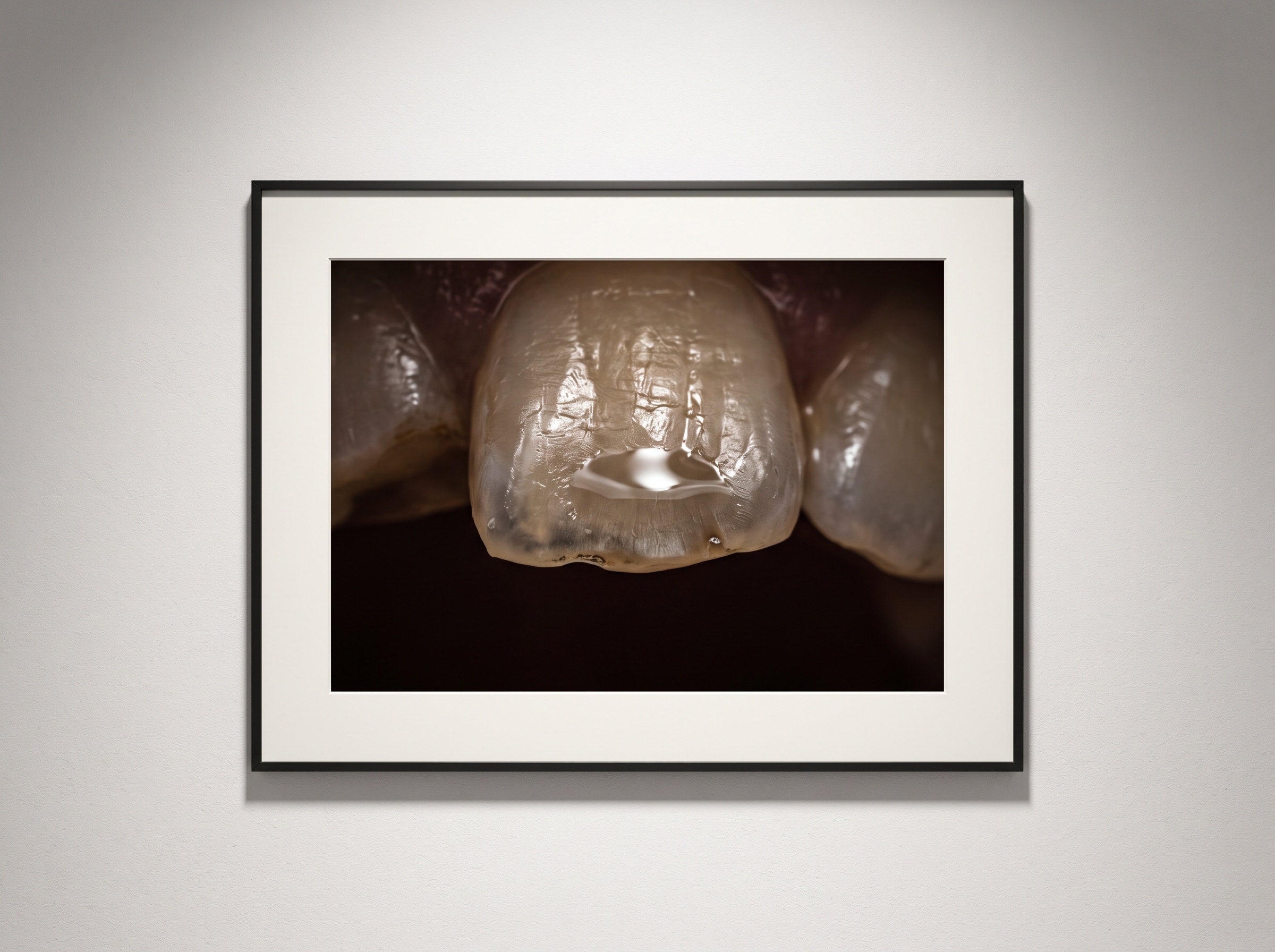
Not every blown highlight deserves rescuing, and this is where craft overtakes technique. A specular highlight is not surface detail at all — it is a mirror image of the flash tube itself, bouncing off the saliva film. Expose to preserve it and you merely render a sharper picture of your own light source, while plunging the true enamel structure into gloom. This is precisely the problem that cross-polarization solves by a different route, extinguishing the mirror reflection with crossed filters so the underlying structure and true shade emerge. The two approaches answer different questions: bracketing asks how do I hold the whole tonal range?, while polarization asks how do I remove the glare entirely? The thoughtful photographer knows which the case in front of them actually requires — a documentation shot of translucency and incisal halo may want the gleam honestly held; a shade-matching reference wants it gone.
Tone-Mapping and the Honest Image
Here lies the quiet danger of HDR. Compressing a huge tonal range into the limited span a screen or print can show requires tone-mapping, and tone-mapping is where photographs go to become lies. Pushed too far it produces the garish, over-cooked look of a bad landscape calendar — haloed edges, unnatural local contrast, a surreal evenness in which nothing is bright and nothing is dark. On a tooth, that is not merely ugly; it is clinically misleading. A flattened, over-processed enamel surface can hide the very translucency, craze lines, and surface character a colleague or laboratory needs to read. The goal of clinical HDR is therefore the opposite of the dramatic: a result so natural it looks like a single, impossibly well-exposed frame. The merge should recover what the eye saw in the room, not invent a tooth that never existed. As ever in this gallery, the measure of a made image is fidelity — and good lighting, the kind covered in our notes on balanced illumination and color management, does more to tame dynamic range at the source than any merge can do after the fact.
When One Good Flash Wins
It is worth saying plainly: most clinical photographs neither need nor want HDR. A well-diffused twin-point flash setup, positioned to soften rather than mirror the specular highlight, will tame the dynamic range of a typical intraoral scene in a single frame — no bracketing, no merge, no risk of motion between exposures. Bracketing earns its place in the harder cases: a full-arch esthetic case under mixed ambient and flash light, a translucent incisal edge against a dark palate, a documentation series where the full tonal story genuinely matters and the patient can hold still. Reaching for HDR when a single considered exposure would do is not sophistication; it is a solution in search of a problem, and it multiplies the chances of a blurred or mismatched merge.
Future Developments
The trajectory points away from bracketing as a manual ritual and toward dynamic range captured in a single instant. Sensor engineers continue to widen the native range of a single exposure, while computational photography — already routine in the smartphone every patient carries — merges multiple sub-exposures internally, in milliseconds, before the photographer ever sees a file. As those pipelines mature and migrate into dedicated clinical cameras, the three-frame bracket may give way to a single press that quietly holds the whole tonal range on its own. What will not change is the judgment underneath it: the decision of which highlights are structure and which are mere reflection, how far a tone may be mapped before it becomes a fiction, and when the gleam on wet enamel should be preserved as the truth of the tooth rather than erased as a flaw. The machine will capture more of the light. Deciding what that light should say will remain, as it has always been, the work of the eye behind the lens.
Sources & further reading:
Sorry, the comment form is closed at this time.