


April 25, 2026 Hyperspectral Imaging in Dentistry: Revolutionary Spectral Analysis for Advanced Oral Diagnostics
Hyperspectral imaging (HSI) represents a groundbreaking advancement in dental diagnostics, offering unprecedented insight into oral tissue composition through comprehensive spectral analysis. This cutting-edge technology captures both spatial and spectral information across numerous wavelength bands, enabling clinicians to detect dental pathologies that remain invisible to conventional imaging methods.
Understanding Hyperspectral Imaging Technology
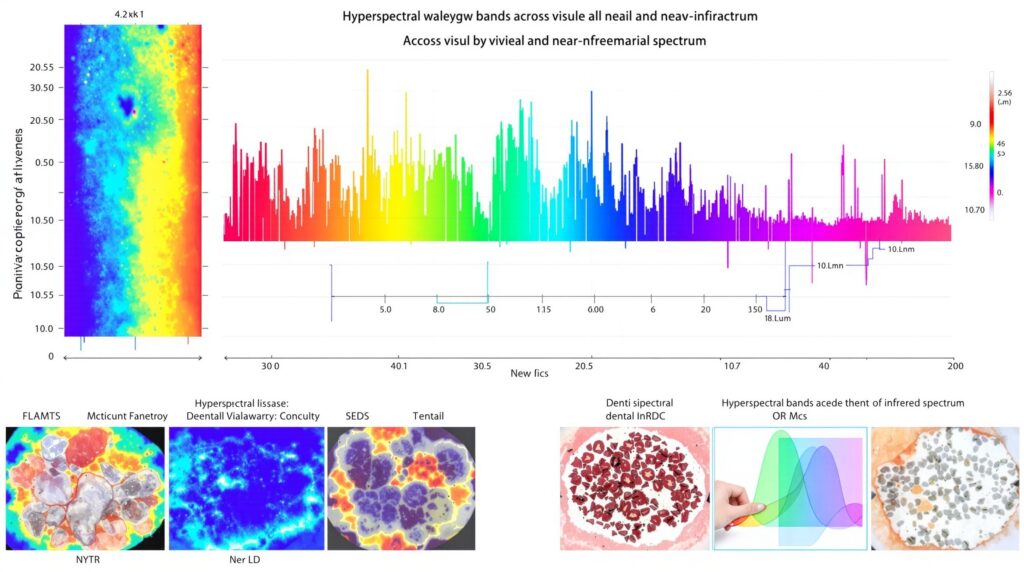
Unlike traditional dental photography that captures only visible light, hyperspectral imaging systems analyze tissues across the entire electromagnetic spectrum, including visible, near-infrared, and short-wave infrared wavelengths. Each pixel in a hyperspectral image contains a complete spectrum of light wavelengths, creating what researchers call a “hypercube” of diagnostic data.

The technology works by detecting how different dental tissues absorb, reflect, and scatter light at various wavelengths. Healthy enamel, dentin, caries, and soft tissues each exhibit unique spectral signatures that can be identified and analyzed through sophisticated computational algorithms.
Clinical Applications in Modern Dentistry
Early Caries Detection
Hyperspectral imaging excels at identifying incipient caries before they become visible to the naked eye or traditional radiography. The technology can detect mineral loss in enamel at the molecular level by analyzing changes in light absorption patterns. Studies demonstrate that HSI can identify demineralized areas up to 6 months earlier than conventional diagnostic methods.
Oral Cancer Screening
Recent research in endoscopic hyperspectral imaging (eHSI) shows remarkable promise for oral squamous cell carcinoma (OSCC) detection. The technology can differentiate between normal and cancerous tissues based on their unique spectral characteristics, potentially revolutionizing early oral cancer diagnosis and improving patient survival rates.
Periodontal Assessment
HSI enables non-invasive evaluation of gingival inflammation and periodontal health by analyzing blood oxygenation levels and tissue perfusion patterns. This capability provides clinicians with quantitative data about soft tissue health that supplements traditional clinical examination findings.
Advantages Over Traditional Imaging Methods
Hyperspectral dental imaging offers several significant advantages over conventional diagnostic techniques:
- Non-invasive Analysis: Provides detailed tissue information without radiation exposure or tissue sampling
- Real-time Results: Delivers immediate spectral analysis during clinical examination
- Enhanced Sensitivity: Detects pathological changes at the molecular level before visual symptoms appear
- Quantitative Data: Generates objective measurements that reduce diagnostic subjectivity
- Comprehensive Coverage: Analyzes multiple tissue types simultaneously across the entire oral cavity

Deep Learning Integration and AI Enhancement
Modern hyperspectral imaging systems leverage artificial intelligence and deep learning algorithms to enhance diagnostic accuracy. Machine learning models trained on extensive hyperspectral datasets can automatically identify spectral patterns associated with specific dental conditions, reducing interpretation time and improving diagnostic consistency.
Research teams are developing specialized neural networks capable of processing hyperspectral dental images to classify healthy tissue, early caries, advanced decay, and various oral pathologies with accuracy rates exceeding 95% in controlled clinical studies.
Current Limitations and Future Developments
While hyperspectral imaging shows tremendous promise, several challenges remain for widespread clinical adoption. Current systems require specialized equipment and technical expertise, making implementation costs significant for many dental practices. Additionally, image processing and analysis demand substantial computational resources and specialized software platforms.
Future developments focus on hardware miniaturization, improved computational efficiency, and streamlined user interfaces. Researchers are working to create portable, chairside hyperspectral imaging devices that integrate seamlessly into existing dental workflows while maintaining diagnostic accuracy and speed.
Clinical Implementation Considerations
Dental practices considering hyperspectral imaging implementation should evaluate several factors:
- Equipment Investment: Initial hardware and software costs, including ongoing maintenance and updates
- Staff Training: Technical education requirements for proper operation and interpretation
- Workflow Integration: Compatibility with existing practice management and imaging systems
- Patient Acceptance: Communication strategies to explain technology benefits and imaging procedures
- Regulatory Compliance: Understanding FDA approval status and clinical validation requirements
The Future of Spectral Dental Diagnostics
Hyperspectral imaging represents the next frontier in dental diagnostic technology, offering unprecedented insight into oral tissue health and pathology. As hardware costs decrease and software capabilities expand, this revolutionary technology will likely become standard equipment in progressive dental practices.
The integration of hyperspectral imaging with other advanced technologies such as optical coherence tomography, artificial intelligence, and predictive analytics promises to create comprehensive diagnostic platforms that transform how dental professionals detect, monitor, and treat oral diseases.
For dental practitioners committed to providing the highest standard of patient care, hyperspectral imaging offers a powerful tool for early disease detection, improved treatment planning, and enhanced patient outcomes. As this technology continues to evolve, its impact on dental medicine will undoubtedly expand, making it an essential component of future oral healthcare delivery.
Sorry, the comment form is closed at this time.