


November 15, 2026 The Distance Between Knowing and Doing: What Radiology Surveys Reveal About the Gap in Everyday Imaging
There is a particular silence that follows a retake. The clinician knows exactly what went wrong before the second film is even positioned — the apex was clipped, the contacts overlapped, the beam was a few degrees off — and knows, too, that none of it was for want of understanding. This is the quiet paradox at the heart of diagnostic imaging, and a fresh survey of knowledge, attitude and practice in dental radiology has put numbers to it once more: practitioners frequently describe correct technique and protection with real fluency, yet their everyday execution drifts well behind what they know. The gap between knowing and doing is not a gap in education. It is a gap in habit, and it is where image quality is quietly lost.
What the Surveys Keep Finding
Knowledge-attitude-practice studies are a blunt but revealing instrument. They ask clinicians what they know, how they feel about it, and what they actually do — and in radiology the three columns rarely line up. Respondents correctly identify dose-reduction principles, name the right receptor positioning, and endorse protective measures, then report habits that contradict their own answers: default exposure settings left unchanged across patient sizes, positioning done by feel rather than by aid, retakes accepted as an ordinary cost of a busy day. The attitude column is often the most telling of all, because it reveals that the drift is not defiance. Clinicians believe in the correct practice; they simply do not always perform it under the pressure of a full schedule. Knowledge, it turns out, is necessary and nowhere near sufficient.
The Retake as Evidence
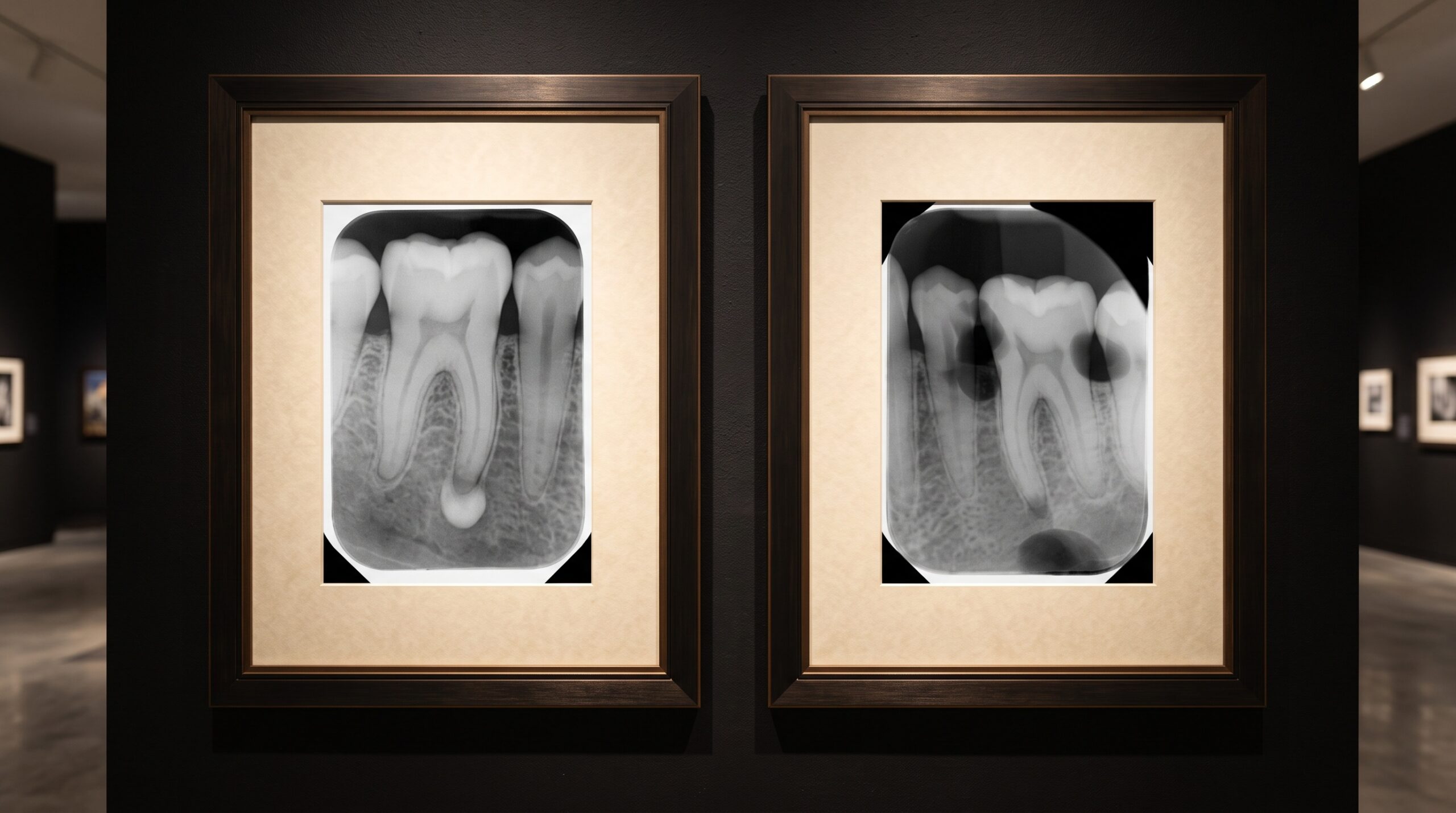
Nothing exposes the gap more honestly than the retake, because a retake is a confession rendered in radiation. The great majority of repeated intraoral films fail for reasons of execution rather than comprehension — a receptor placed too shallow, a vertical angle that foreshortens, a horizontal angle that smears the contacts into an unreadable overlap, a cone-cut from careless alignment. Each of these is a technique a clinician can describe perfectly on a questionnaire and still commit at the chair. The cost is not abstract: every retake doubles the dose for that image and, multiplied across a career and a patient population, becomes a meaningful quantity of avoidable exposure. The discipline of placing a premolar bitewing so the contacts actually open is the difference between a diagnostic film and a second attempt, and it is executed, not merely understood.
Why Good Knowledge Decays Into Habit
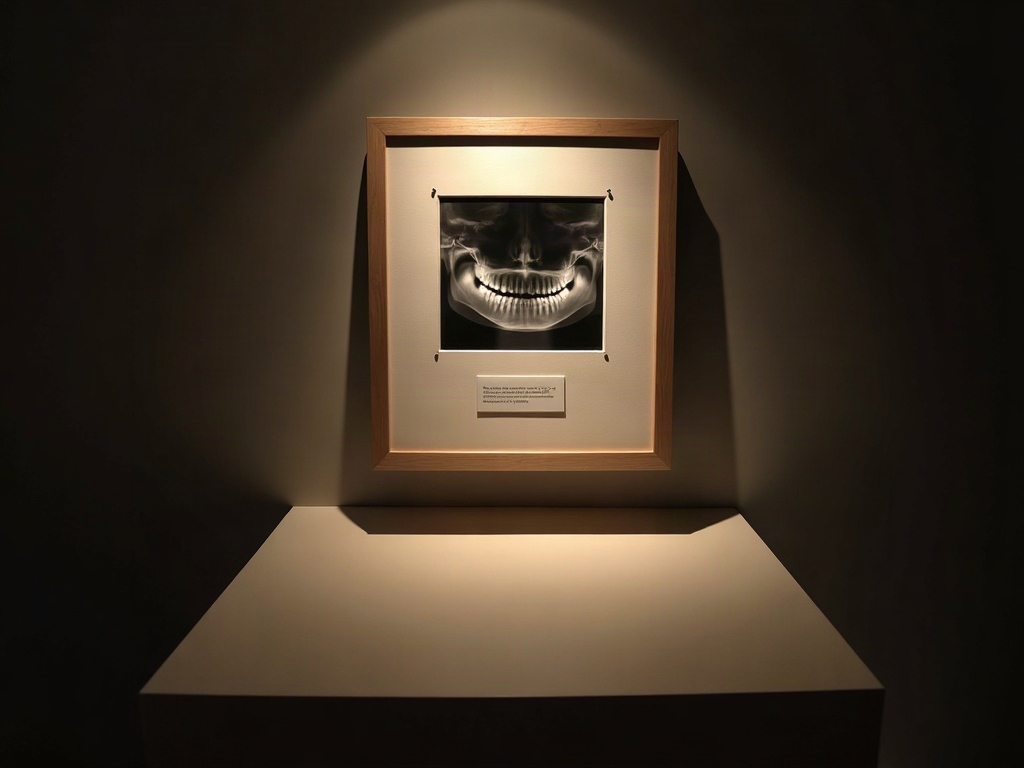
The mechanism behind the gap is mundane and therefore durable. Under time pressure, the brain reaches for the cached routine rather than the considered method, and the cached routine is whatever was done most often, not whatever was learned most recently. A setting that produced an acceptable image yesterday becomes the default today, regardless of whether this patient’s anatomy warrants it. An artifact that appears intermittently — the ghosted shadow of a panoramic phantom image from an unremoved earring or a misjudged chin position — is tolerated rather than traced to its cause, because tracing it costs attention the schedule does not grant. None of this reflects ignorance. It reflects the ordinary economics of a working day, in which the path of least resistance almost always wins, and in which correct technique loses precisely because it asks for a moment of deliberate thought.
Closing the Gap Is Structural, Not Educational
The instinctive response to a knowledge-practice gap is to teach more, but more theory lands on the wrong side of the divide. The clinicians already know. What changes behaviour is structure: making the correct technique the easiest technique to perform. A standardized exposure protocol posted at the unit removes the need to recall settings under pressure. A positioning aid that only fits one way removes the opportunity for a bad angle. A documented quality standard — the kind of clarity that the ADA’s work on digital radiograph quality aims to make routine — turns a vague sense of good enough into a defined threshold. These interventions work not because they inform but because they reshape the moment of action, so that doing the right thing requires less effort than doing the habitual one.
Measuring the Pile
A gap that is never measured is a gap that never closes, and most practices have no idea what their retake rate actually is. The individual retake is invisible — one more film, quickly forgotten — but the aggregate is a hard number, and a hard number is the beginning of improvement. A practice that tracks its retake rate by operator and by film type stops guessing and starts seeing: that most repeats cluster on a single technique, or a single time of day, or a single unit whose positioning geometry is subtly off. This is the same shift in perspective that distinguishes reading one radiograph from curating a collection; the pattern lives in the aggregate, not the instance. Reviewing retakes routinely also reframes them culturally, from private failures to be hidden into shared data to be learned from — and that cultural change is often the one that moves the number most.
When Feedback Arrives in Time
The deepest reason the gap persists is temporal: the feedback that would correct a technique arrives too late to act on it. By the time a clipped apex is noticed, the patient has been dismissed and the dose is already delivered; the lesson, if it registers at all, applies only to the next patient. Emerging tools are beginning to collapse that delay. Systems that assess exposure and positioning at the instant of capture — flagging a likely retake before the receptor is even removed, or suggesting an adjustment while the correction still costs nothing — move the moment of learning to the moment of action. The same analytic capability that lets software read the finished radiograph is being turned upstream, toward the making of the image rather than its interpretation. Feedback that is immediate does not merely inform the next film; it closes the loop on this one.

Future Developments
The gallery has always insisted that an image is a made thing, and the knowledge-practice gap is a reminder of how much the making matters. A radiograph is not conjured by understanding; it is produced by a hand, at an angle, with a setting, under a clock — and every one of those variables can betray the finest knowledge in the room. The trajectory ahead is toward making the correct act effortless: exposure assistants that adapt to anatomy without being asked, positioning systems that permit only the right geometry, quality review that happens continuously rather than at audit, and protocols sound enough that imaging in moderation becomes the default rather than the exception. The survey’s finding is, in the end, a hopeful one. The hardest part — knowing what good imaging requires — is already done. What remains is the more tractable work of building a practice in which knowing and doing finally meet, and the clean film becomes not a matter of concentration but a matter of course.
Sources & further reading:
- Knowledge, attitude, and practice in diagnostic dental radiology (survey coverage)
- Radiography image quality and technique research (overview)
No Comments