


August 22, 2026 The Ghost on the Other Side: How a Panoramic X-Ray Paints a Shadow Where No Bone Exists
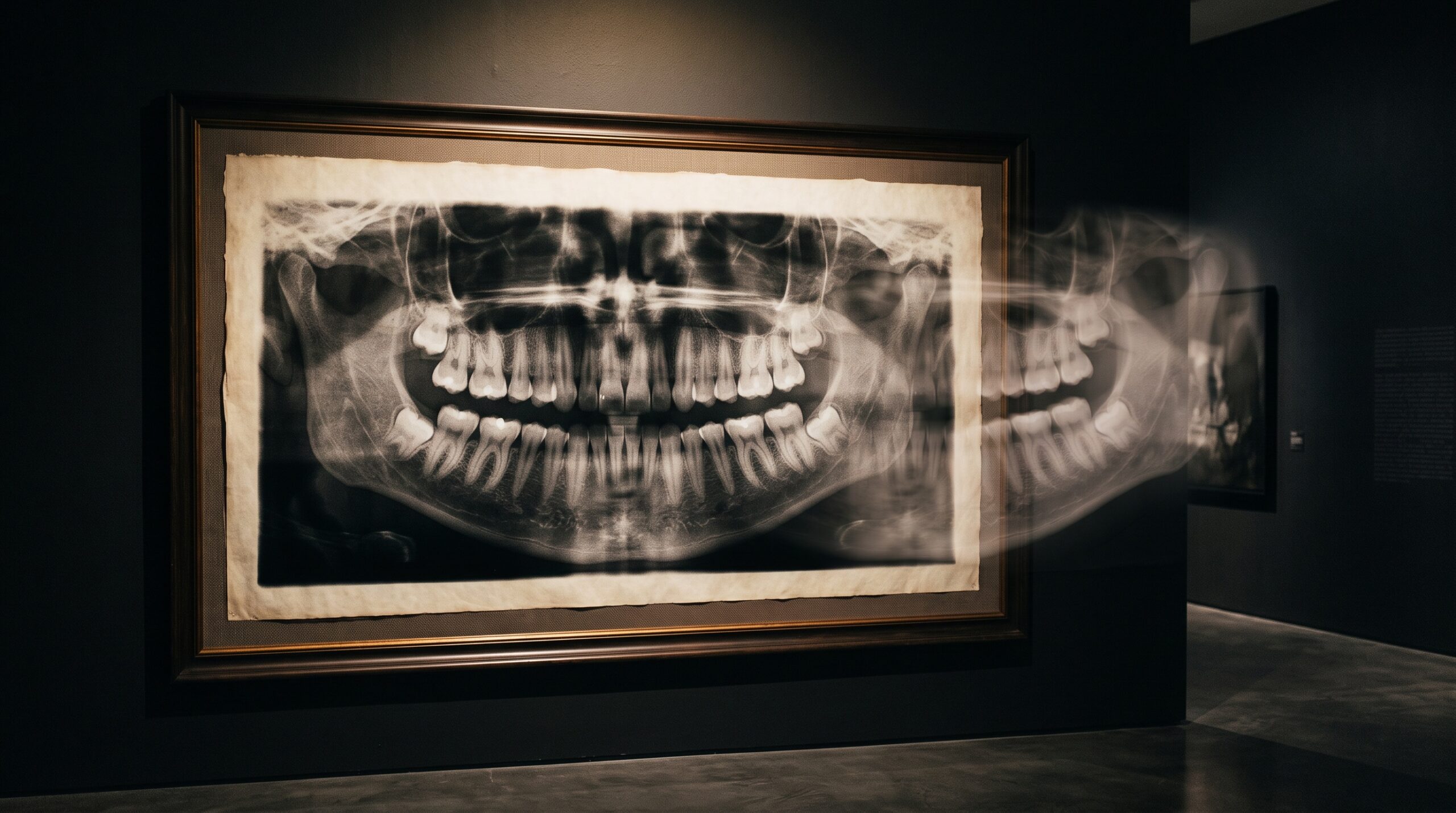
Look long enough at panoramic radiographs and you begin to notice a faint second presence in them. A soft curved band arcs where no bone should be. A pale diagonal shadow drapes across the ramus. A ghostly duplicate of a structure floats on the far side of the jaw, blurred and a little too large, as though the picture were quietly haunted. New readers reach for the obvious explanations – a fault in the machine, a patient who moved, a plate exposed twice. Almost always it is none of these. It is geometry doing precisely what it was built to do.
The panoramic ghost is one of the most elegant illusions in dental imaging, and one of the most misread. It is not a flaw laid over the image; it is a real anatomical structure, projected by the machine’s motion onto the wrong side of the film. To understand it is to understand how the panoramic sees at all.
The Machine That Paints in Motion
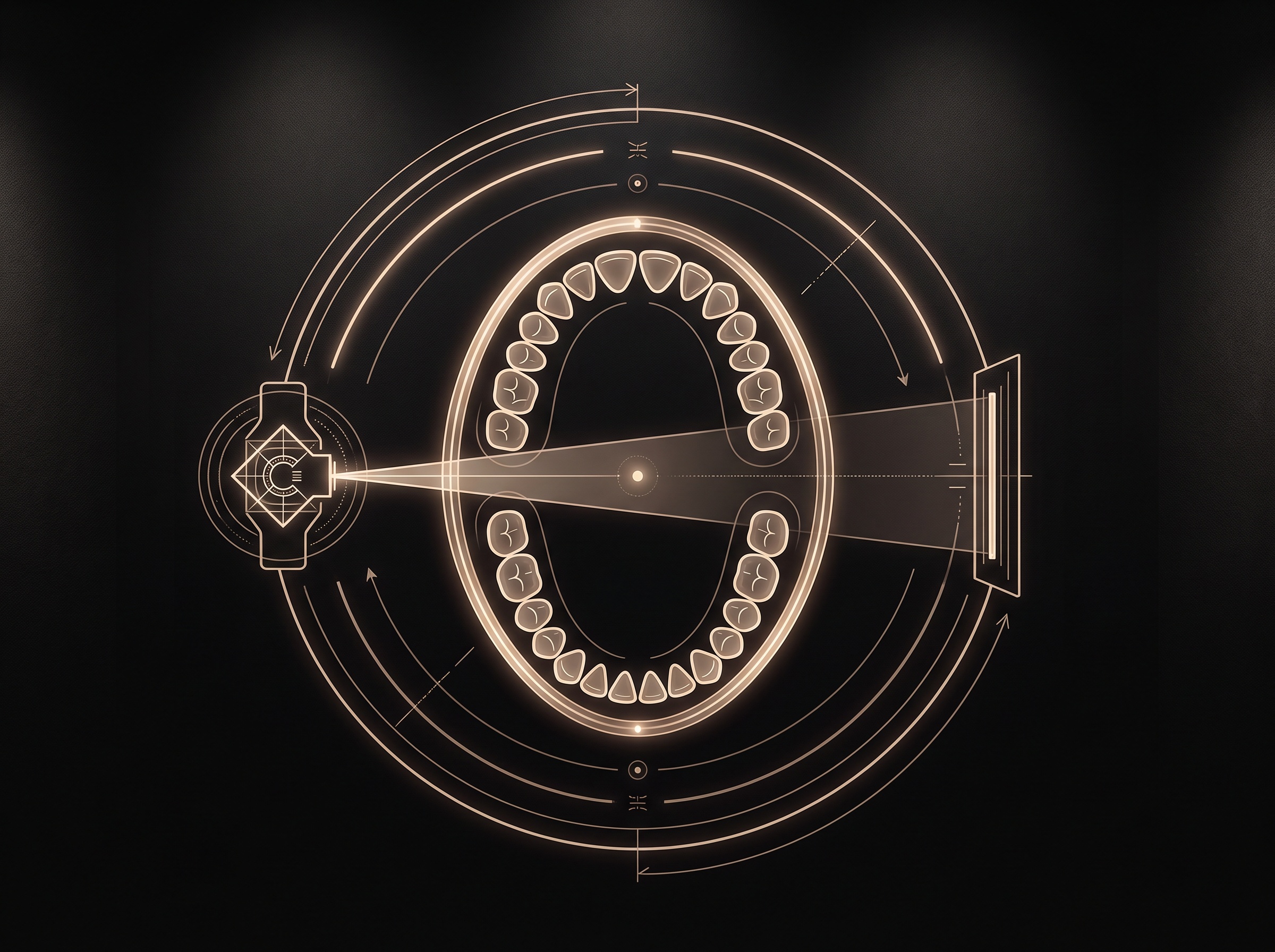
A periapical or bitewing radiograph is a snapshot: a still cone of radiation, a still sensor, a single instant. A panoramic is nothing of the kind. It is a slow performance. An X-ray source and a narrow, slit-shaped detector sit on opposite sides of the head and orbit it together in a sweeping, curved path, the tube always firing across the patient toward the receptor gliding on the far side. The image is not captured all at once but written column by column, a thin vertical sliver at a time, as the assembly travels from one ear around to the other.
This rotational tomography is what lets a flat image follow a curved jaw. As we explored in the focal trough that builds one sharp image from a curtain of blur, only structures lying within a curved, horseshoe-shaped zone – the focal trough – are rendered sharply; everything nearer or farther is smeared away by the motion. But smeared is not the same as erased. A structure outside the trough does not vanish. It is still struck by the beam, still casts its shadow onto the moving detector – only now the geometry sends that shadow somewhere it does not belong.
Why a Ghost Appears
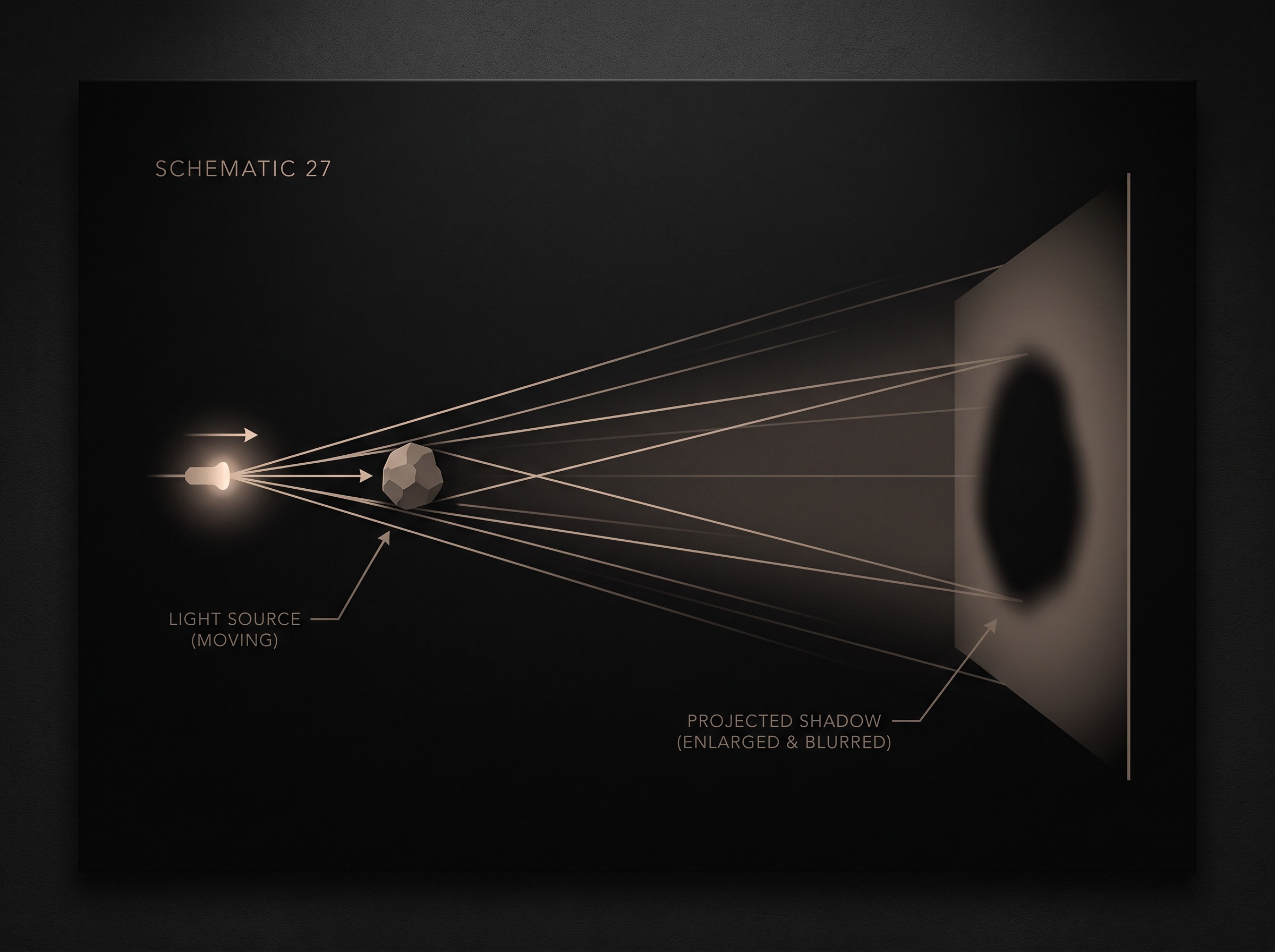
Consider a dense structure sitting between the X-ray source and the center of rotation – well behind the focal trough, on the source side of the arc. As the tube sweeps, that structure is back-lit and thrown across the head onto the detector traveling on the opposite side. The result is a shadow that lands not where the object is, but on the contralateral side of the image entirely.
Because the object sits far from the detector and close to the source, it is projected with considerable magnification – the ghost is always larger than its origin. Because it lies outside the focal trough, it is rendered unsharp – the ghost is always blurred. And because the panoramic beam is angled slightly upward as it fires, the projected shadow is displaced vertically – the ghost always sits higher than the real structure that cast it. Opposite side, magnified, blurred, lifted upward: four signatures, produced together, every time. Recognize the set and the apparition names itself.
A Field Guide to the Regular Ghosts
Because the anatomy of the head is broadly symmetric and the machine’s path is fixed, the same phantoms recur across patient after patient. Learning them by sight is a large part of the craft.
The contralateral mandible is the classic offender: the ramus or the angle of one side thrown across to overlie the opposite ramus, a sloping ghost that can be mistaken for a lesion or an extra bony margin. The hard palate commonly ghosts as a soft horizontal or gently curved band draped across the maxillary sinuses and roots. The hyoid bone casts a pale shadow that can drift over the anterior mandible. The cervical spine, if the patient stands with the neck curved rather than straight, projects a dense vertical shadow up the midline that can swallow the incisors in a column of grey.
And then there are the ghosts we bring on ourselves: metal. An earring, a nose stud, a hairpin, a lead apron collar riding too high – anything radiopaque left in the beam is projected with brutal clarity to the opposite side, producing a bright, well-defined phantom that has launched more than one anxious second look. The remedy for that family is not interpretive skill but the checklist before exposure: remove the earrings, drop the apron, seat the collar low.
Reading the Ghost Rather Than Being Fooled
The diagnostic danger of a ghost is that it apes pathology. A blurred, magnified shadow over a sinus can read as opacification; a ghosted ramus can suggest a mass; a doubled band can mimic a fracture line. The discipline is to test any suspicious shadow against the ghost’s four fingerprints before treating it as real. Ask: is there a plausible dense structure on the opposite side that could have cast this? Is the shadow larger and less sharp than the genuine anatomy around it? Does it sit higher than its likely source? If the answers line up, you are looking at an apparition, not a finding.
This belongs to the same interpretive lineage as recognizing cervical burnout, the radiolucent illusion that mimics caries at the tooth’s neck – artifacts of physics dressed as disease. And it shares a family with the streaks and phantoms of three-dimensional imaging; the beam-hardening and metal-streak artifacts that distort a CBCT scan are the volumetric cousins of the panoramic ghost, born of the same truth that a reconstruction can only ever be as honest as the geometry that built it. When a ghost genuinely obscures the region of interest, the answer is often not to squint harder but to reach for the small, focused intraoral view the panoramic was never meant to replace.
Future Developments
The trajectory is toward machines that both make fewer ghosts and help us name the ones that remain. Positioning is where most panoramic artifacts are won or lost, and newer units guide it more firmly – face-scanning cameras, live bite-guide alignment, and posture prompts that coax the cervical spine straight so it stops projecting up the midline. On the reading side, the deep-learning models already learning to grade positioning and flag technique errors are being trained to recognize the regular phantoms outright, quietly labelling a shadow as “contralateral ramus” or “hyoid” so a clinician spends attention on anatomy rather than apparitions. That work rests on exactly the patient, expert annotation of panoramic radiographs that teaches a machine to tell a ghost from a lesion.
None of it changes the underlying physics, and it should not. The ghost is not a defect to be engineered away; it is the honest signature of a machine that paints a curved world in motion. The most sophisticated reader is not the one who never sees a phantom, but the one who sees it, greets it by name, and lets the living anatomy stand clear beneath.
Sources & further reading:
Sorry, the comment form is closed at this time.