


October 14, 2026 The Surface That Fights the Lens: Photographing Gold, Ceramic, and Metal Restorations Without Blowing the Highlight
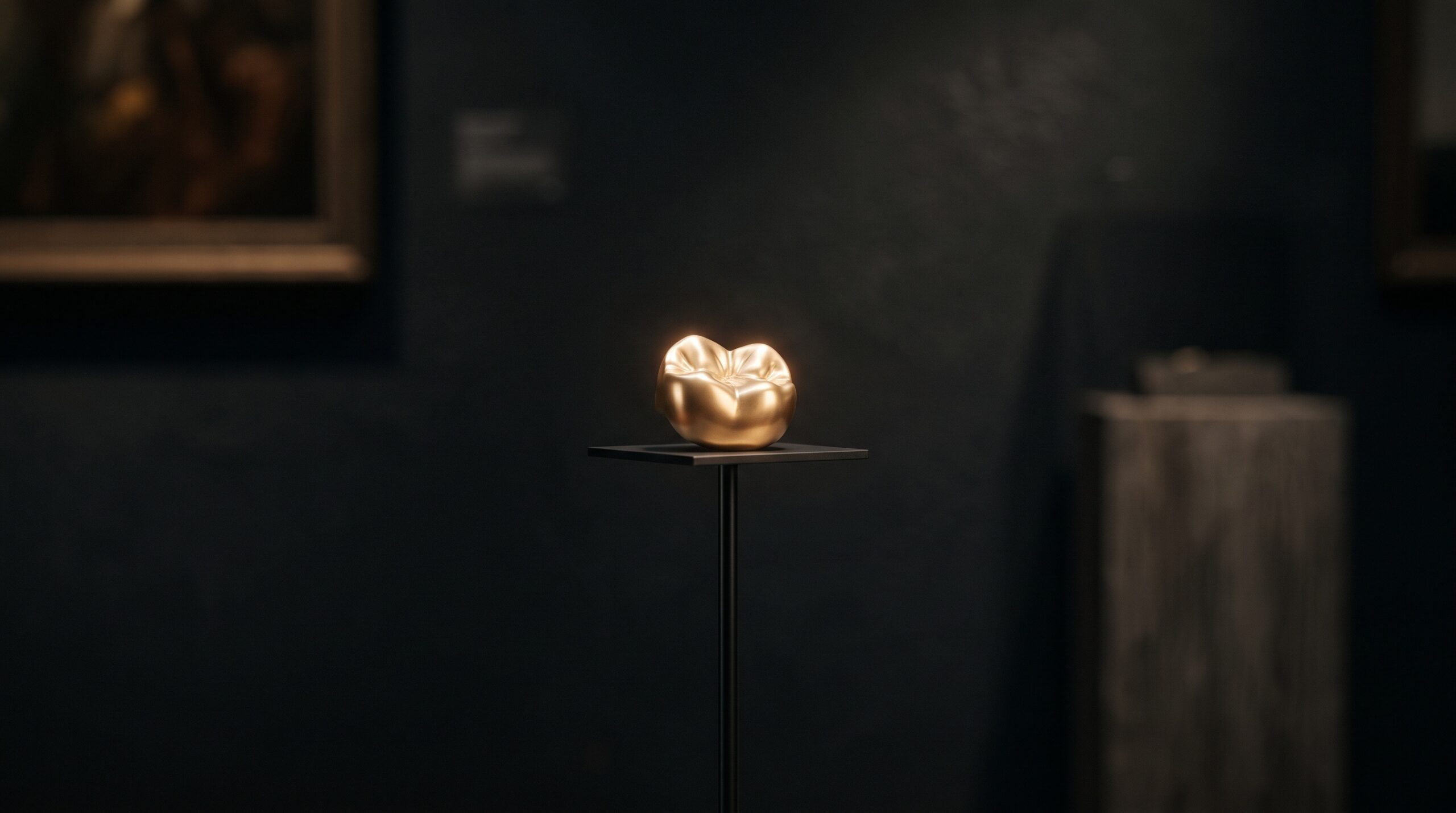
The finest work in a mouth is often the hardest to photograph. A polished gold onlay, a high-glaze ceramic crown, a burnished amalgam margin — these are the restorations a clinician most wants to document, and the ones that most reliably defeat the camera. Press the shutter and the flash comes straight back off the surface as a blank white disc, a hotspot that eats the very detail you were trying to record: the margin, the anatomy, the shade, the quiet craftsmanship of the fit. The restoration looks flawless to the eye and ruined in the frame. The reflection is not a failure of the camera or the clinician; it is physics behaving exactly as it must. Understanding why each material fights the lens in its own way is the first step to taming it.
Why the highlight blows: specular versus diffuse
Every surface returns light in two ways at once. Diffuse reflection scatters light softly in all directions — it is what lets you read texture, tone, and shade on a matte surface such as enamel or dentin, because wherever the lens sits, a little of that scattered light arrives. Specular reflection is the mirror component: light bounces off at a tight angle equal and opposite to the angle it struck, concentrated rather than spread. A dull surface is nearly all diffuse. A polished restoration is heavily specular, and that specular ray carries the raw intensity of the flash almost undimmed. When the geometry lines up — flash, surface, and lens forming a mirror angle — that undimmed ray lands directly on the sensor and clips to pure white. That white disc is not glare laid over the image; it is the flash, reflected. No exposure adjustment recovers detail that was never recorded, because at that spot the surface sent the camera a mirror of the light source and nothing of itself.
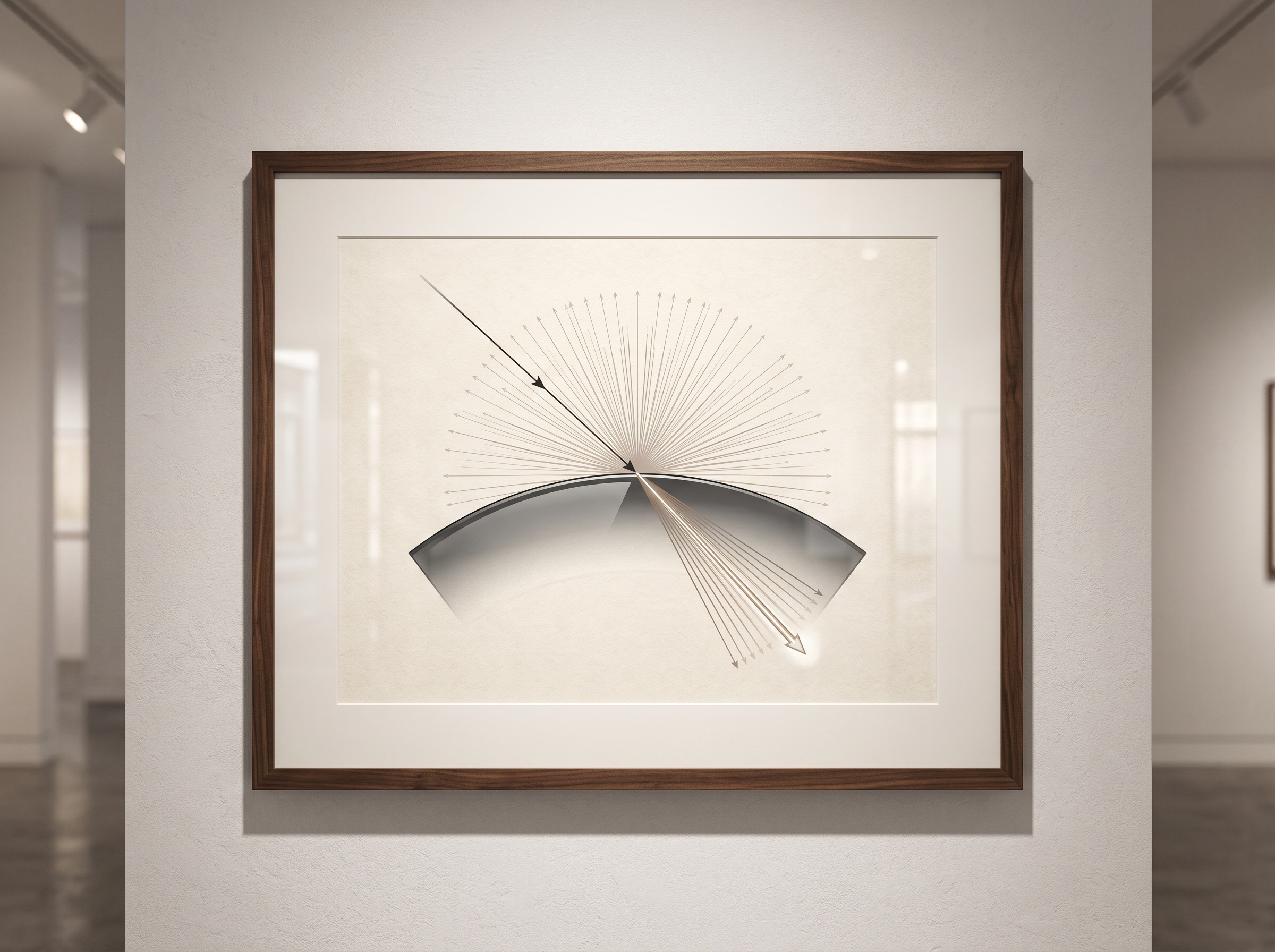
This reframes the whole task. You are not fighting brightness; you are managing a reflection. And a reflection can be moved, enlarged, softened, or polarized away. Three levers do almost all the work: the angle between light, surface, and lens; the size of the light source as the surface sees it; and the polarization of the light. Master those and the blown highlight becomes a choice rather than an accident.
Gold and polished metal: taming the mirror
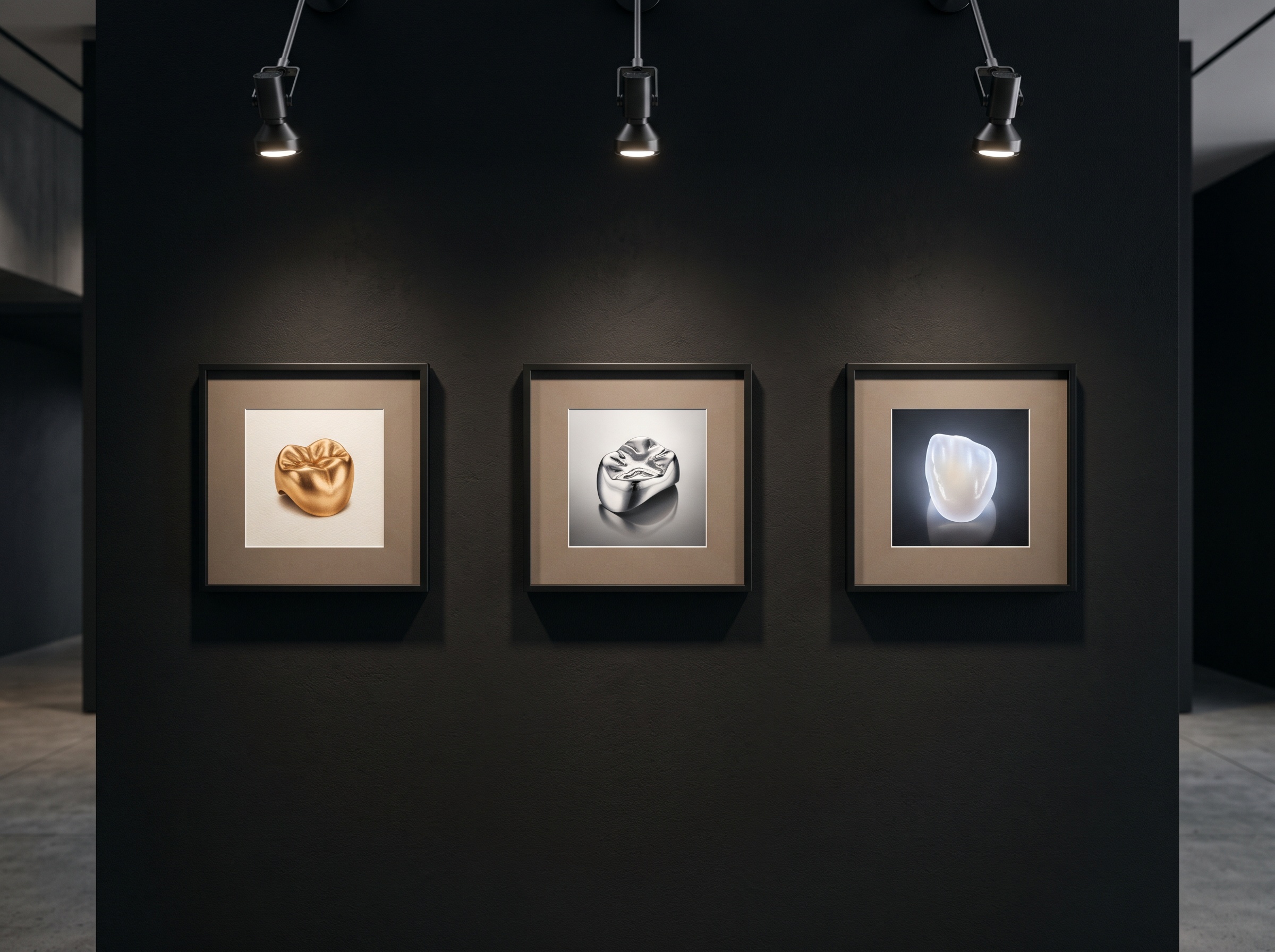
Gold is the purest expression of the problem. A well-polished gold restoration is, optically, a warm-toned curved mirror — it has almost no diffuse component to fall back on, so what the camera records is overwhelmingly a reflection of whatever surrounds it. Point a small bare flash at it and you get a small, savage hotspot. The remedy is counterintuitive: do not make the light dimmer, make it bigger. A broad, diffused source — a softbox or a diffuser panel over a twin flash — still reflects in the gold, but now the reflection is a large, gentle, graduated sheen that wraps around the curvature instead of a pinpoint that clips. The surface still looks metallic and bright; it simply reflects a soft rectangle of light rather than a hard point of it. Polished amalgam and cast alloy behave the same way but reflect cool and neutral rather than warm, so the sheen reads silver-grey. With any mirror-like metal, also break the exact mirror angle: tilt the light or the camera a few degrees off the plane of straight-back reflection so the brightest specular ray misses the lens entirely, leaving only the softened wrap-around to describe the form.
Ceramic and zirconia: the second reflection beneath the glaze
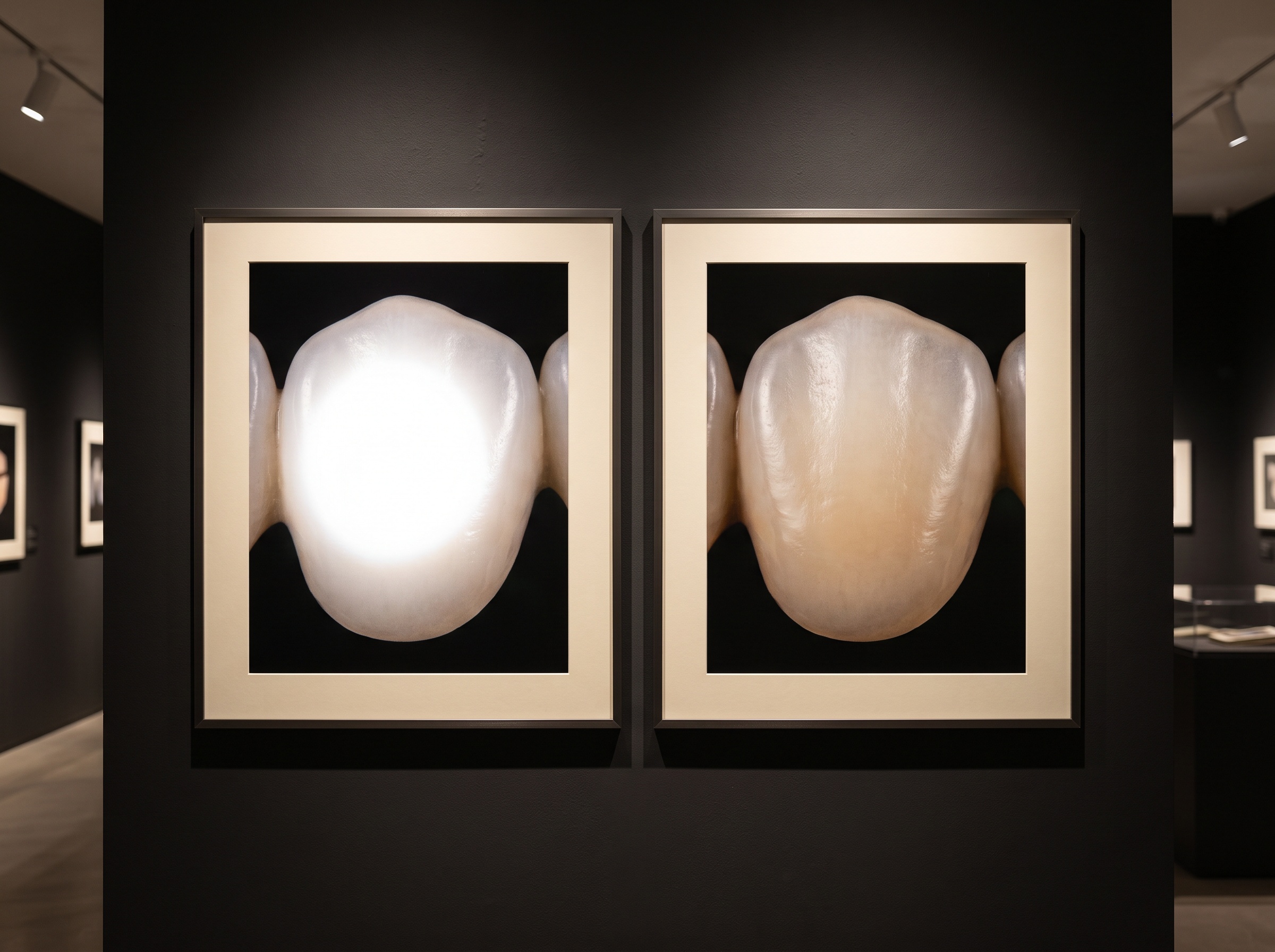
Ceramic restorations add a layer of difficulty that metal does not have. A glazed porcelain or lithium-disilicate crown carries two reflections stacked on top of each other: a sharp surface reflection off the glassy glaze, and a softer, deeper glow from light that penetrated the translucent ceramic, scattered within it, and came back out — the very subsurface scatter that gives good ceramic its lifelike depth. The surface glare is the enemy; the inner glow is the prize. Diffusion again enlarges and softens the surface reflection, but ceramic rewards a further step: because the unwanted glare is a surface specular reflection, it is strongly polarized, which makes it the ideal candidate for a polarizing filter. The same disciplined control of stray light that a black contrastor brings to isolating a single tooth pairs naturally with polarization here — cut the surface glare and the crown’s internal translucency, shade gradient, and glaze texture emerge from beneath it, exactly the qualities a ceramist needs to see.
Diffuse, polarize, or move: the three remedies in practice
In the operatory these levers combine rather than compete. Diffusion is the first reach for every reflective material — a diffuser over the flash heads converts a cruel point source into a forgiving broad one, and alone solves most metal hotspots. Polarization is the specialist tool for glossy, glazed, and wet surfaces: a polarizing filter crossed against polarized flash erases the surface specular layer almost completely, which is transformative on ceramic and on saliva-glossed enamel, though it is overkill — and can look flat — on matte work. Geometry is the free remedy that costs nothing: a few degrees of change in flash position or camera angle slides the mirror reflection off the region of interest. Good color discipline underwrites all of it, because a restoration documented for the lab must be true in hue as well as free of glare — the kind of fidelity that begins with setting white balance from a gray card at the moment of capture rather than guessing afterward. And when a restoration mixes materials — a gold margin beside a ceramic body — no single setting serves both, so the frame becomes a negotiation, usually settled by diffusing broadly, polarizing for the ceramic, and accepting a controlled, soft sheen on the metal rather than a dead matte that would misrepresent it.
Exposing for the brightest thing in the frame
Even with the reflection softened, a bright restoration will pull an averaging meter astray, and the instinct to brighten the shot only drives the sheen back toward white. The discipline is to expose for the highlight: let the surrounding tissue sit a touch darker if it must, but protect the brightest relevant surface from clipping, because detail lost to pure white is unrecoverable while detail hiding in a slightly dark mid-tone can be lifted. Watching the histogram or the highlight-clipping warning is worth more than trusting the preview. For the most demanding cases — a full gold crown beside pale enamel, a tonal span no single exposure can hold — the answer is the same one used for wet, glossy anatomy generally: the bracketing and high-dynamic-range technique developed for photographing wet enamel, capturing several exposures and merging the range so the metal keeps its sheen and the tissue keeps its tone. Dulling sprays, which coat a surface in a temporary matte film, exist for bench and lab photography but sit uneasily chairside and are best left to the technician’s studio; in the mouth, light management is cleaner than surface coating. Throughout, the composition rules do not change — the restoration still wants the deliberate framing and retraction of a proper clinical portrait, only now with the added vigilance of a photographer watching the surface for the moment the mirror turns toward the lens.
Future Developments
The reflective restoration is where computational photography will arrive next in the operatory. Multi-shot polarized capture — taking a rapid series at different polarization angles and separating the surface specular layer from the subsurface diffuse one in software — already exists in materials science and portrait work, and would let a clinician record both the honest glaze reflection and the pure underlying shade of a ceramic crown from a single trigger. High-dynamic-range sensors continue to widen the exposure latitude available in one frame, shrinking the need to bracket a gold-and-enamel span by hand. And AI-assisted highlight handling is beginning to distinguish a genuine specular hotspot from true surface detail, recovering texture at the edge of a blown region that older tools could only clip. Yet none of this retires the craft, because the physics underneath is fixed: a polished surface will always return the brightest light it is given as a mirror, and the photographer who understands that — who diffuses, polarizes, and angles with intent — will keep making images in which the gold still gleams, the ceramic still glows from within, and the margin the hand worked so carefully to perfect is finally, clearly, seen.
Sources & further reading:
- Specular vs diffuse reflection and the physics of glossy surfaces (overview)
- Dental photography: lighting, polarization, and documenting restorations (clinical overview)
No Comments