


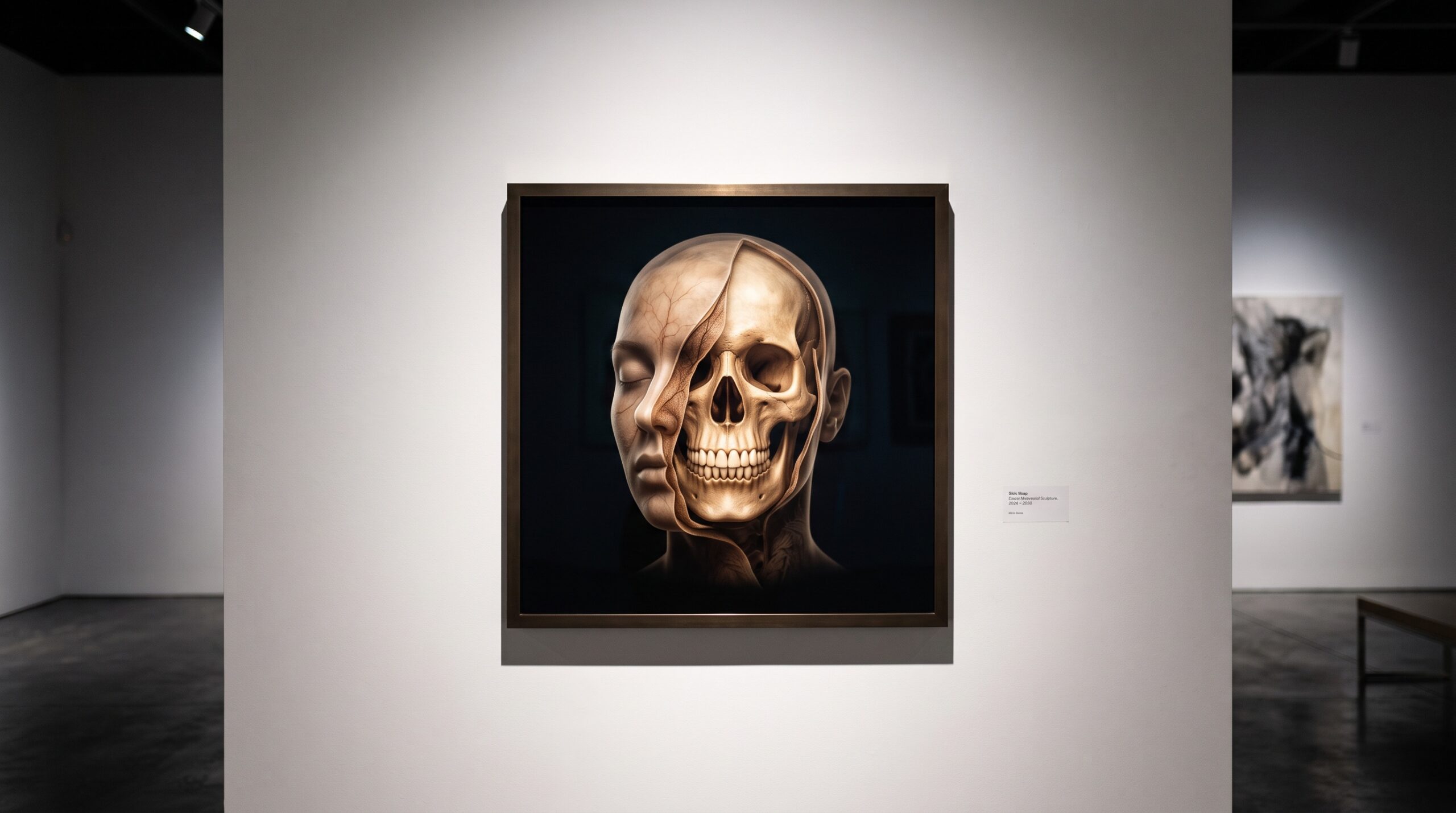
October 3, 2026 The Virtual Patient: Fusing Face Scans, CBCT, and Intraoral Data Into One 3D Record
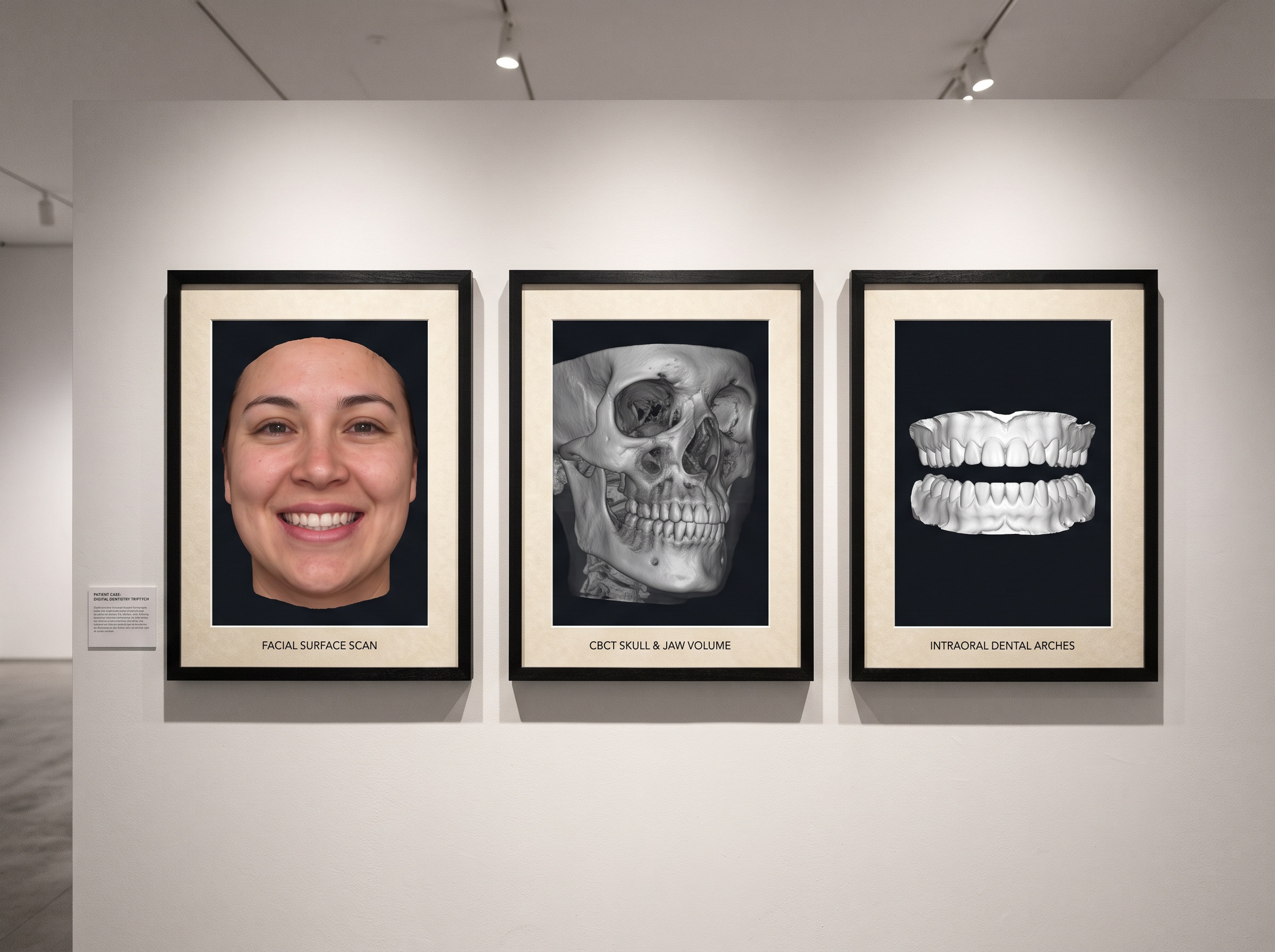
Consider what each of our instruments actually knows. A facial surface scan captures the smile in exquisite colour and curvature — the lips at rest, the way light falls across the cheek — yet it stops at the skin and has no idea what lies beneath. A cone-beam scan maps the jaw, the sinuses, the root of every tooth in three dimensions, but renders the soft tissue as a vague grey ghost and the enamel surface as a blur of scatter. An intraoral scan records the occlusal surfaces to a precision measured in microns, and knows nothing of the face those teeth belong to. Each is a masterpiece of partial sight. The virtual patient is the act of persuading all three to describe the same person, in the same space, at the same time.
Three Truths, Three Blind Spots
The temptation is to treat these as competing modalities, to ask which is best. They are not rivals; they are collaborators that have never been introduced. Their blind spots are almost perfectly complementary. The face scan owns the esthetic envelope — the smile line, the lip dynamics, the facial midline against which any restoration will ultimately be judged. The CBCT owns the hidden architecture — bone volume, nerve canals, the exact axis along which an implant can safely be driven. The intraoral scan owns the truth of the surfaces, the margins and contacts that no volumetric scan resolves cleanly. Alone, each forces the clinician to hold the others in imagination, mentally superimposing bone onto smile onto bite. Fused, that imaginative leap becomes a measurable, rotatable object — and judgment stops competing with memory.
Registration: The Quiet Art of Alignment
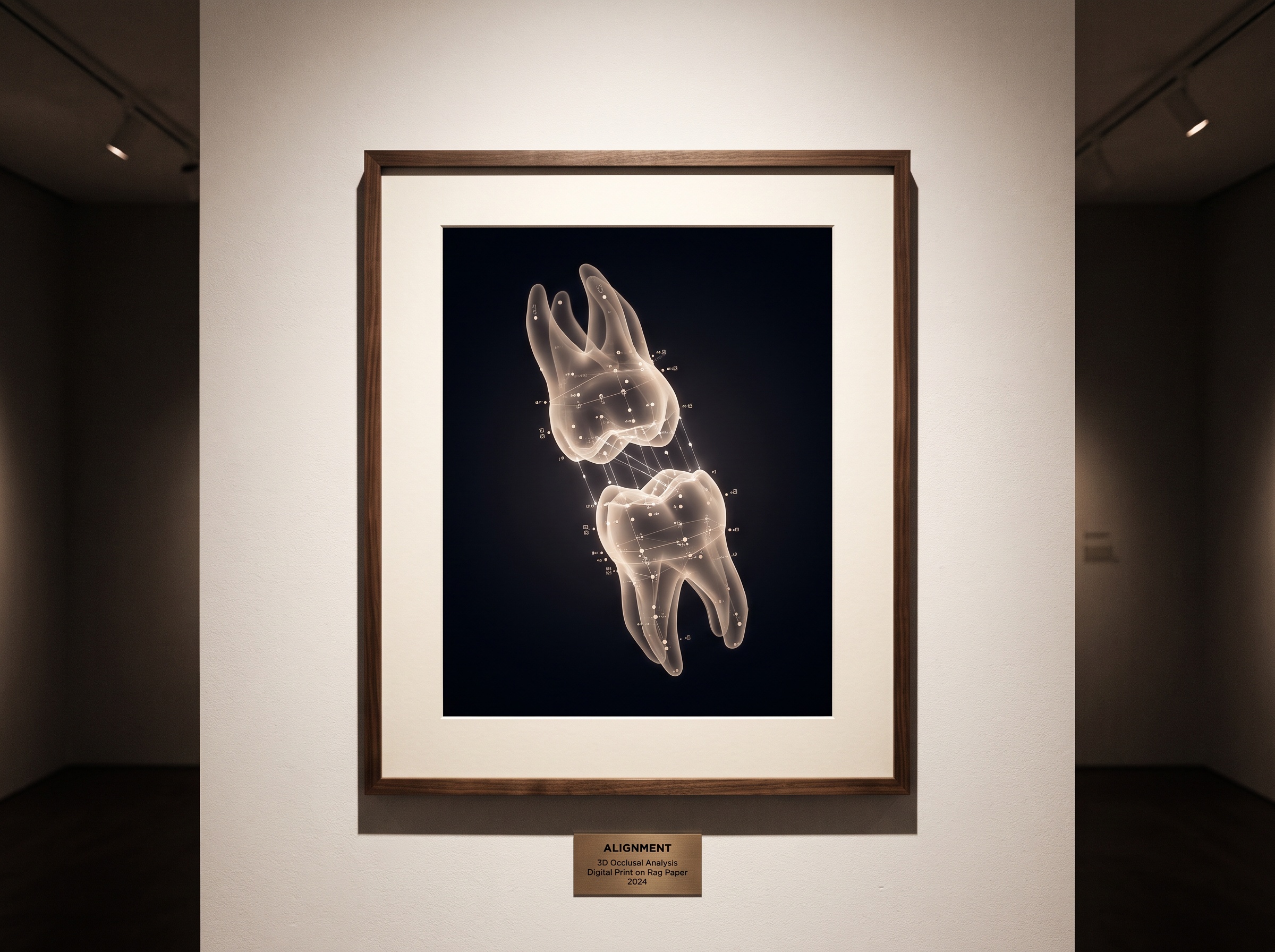
The entire enterprise rests on a single problem that sounds trivial and is anything but: how do you know that a point in the face scan is the same point in the CBCT? This is registration, and it is where the craft lives. Two scans captured on different machines, at different moments, in different coordinate systems, must be brought into one shared space with sub-millimetre agreement. The usual bridge is a feature both scans can see honestly — most elegantly the teeth themselves, or scan bodies and reference markers placed so that each modality records an unambiguous common landmark. The software then rotates and translates one dataset until those shared points collapse onto their twins. Get it right and the layers lock together as if they had always been one. Get it wrong by half a millimetre and the planned restoration sits in the wrong jaw, the implant threatens a nerve that has quietly shifted, and the beautiful composite becomes a confident lie. The same discipline that lets a clinician read depth from the parallax of a shifted tube — the logic explored in our account of combining MRI and CBCT to picture the temporomandibular joint — is the discipline that governs fusion: alignment is everything, and it must be earned, not assumed.
From Point Cloud to Patient
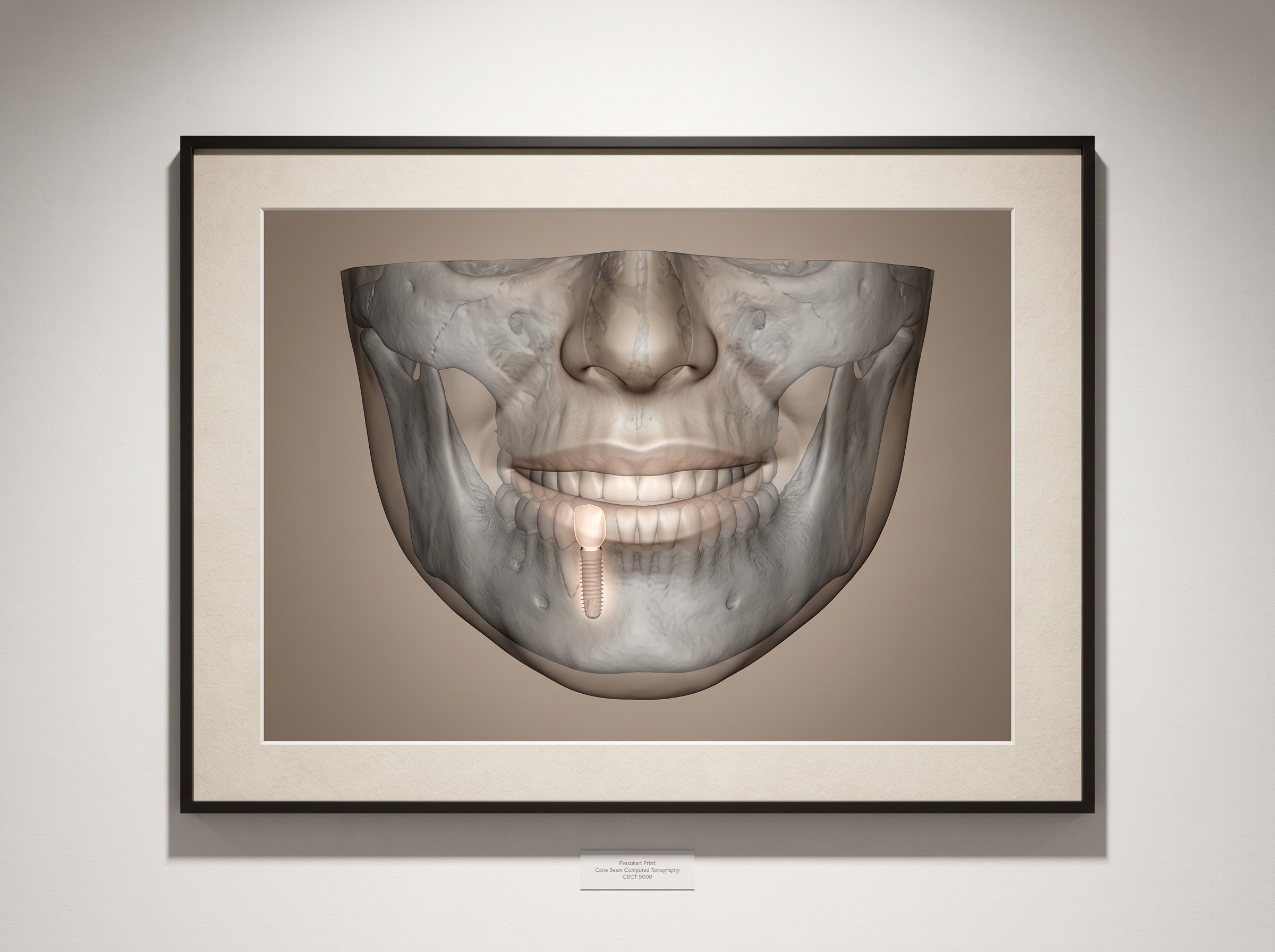
Each source arrives in a different native language. The CBCT speaks in voxels — a dense volumetric grid of densities. The surface scans speak in meshes and point clouds — triangulated skins with no interior. Fusion is as much a problem of translation as of alignment: the volume must be surfaced where it meets the mesh, the mesh must be anchored where it meets the volume, and the result reconciled into a single model a clinician can navigate without seeing the seams. Done well, the join is invisible. The user turns a smiling face, fades the skin to translucency, and finds the bone and dentition exactly where anatomy says they must be. What began as three files from three machines becomes one patient — not a photograph of a patient, but a working model of one.
Planning Inside the Model
This is where the virtual patient stops being a visualisation and becomes an instrument. With the face, bone, and teeth aligned, a planned implant can be positioned in the CBCT and immediately checked against the smile line in the face scan — is the emergence profile going to serve the lip, or fight it? A restoration can be designed on the intraoral surfaces and judged, before a single bur touches enamel, against the facial midline and the curve of the lower lip. The fused record turns the old sequential gamble — plan the surgery, then hope the esthetics follow — into a single conversation. It is the natural destination of the overlay thinking behind augmented-reality guided surgery: once the data lives in one coordinate space, it can be projected, simulated, and rehearsed as one. The model also becomes the shared reference every member of the team argues from — surgeon, restorative dentist, and laboratory all looking at the same patient rather than three partial sketches of them.
The Discipline of Clean Inputs
A fused model is only ever as honest as its weakest scan, and this is the humbling part. A patient who swallows or shifts during a CBCT smears the bone the merge will trust implicitly. An intraoral scan stitched with drift carries that error, magnified, into the composite. A face captured mid-expression rather than at a repeatable rest position registers a smile the patient does not actually wear. Fusion does not forgive these; it compounds them, laundering three separate uncertainties into one authoritative-looking object. This is precisely why the unglamorous virtues still rule — a motionless capture, a scanner light enough that the patient barely notices it and barely moves, the kind of ergonomic, low-burden acquisition we examined in our look at the featherweight scanner and the craft of a scan the patient barely notices. The virtual patient rewards the clinician who still treats each individual scan as if it were the final image, because in the composite it very nearly is.
Future Developments
The trajectory is toward fusion that stops being a deliberate, multi-step assembly and becomes simply how imaging works. Registration is already migrating from manual landmark-picking to algorithms that find the shared geometry on their own, and the same reconstruction intelligence that now rescues detail from a low-dose CBCT will increasingly reconcile modalities without a human nominating a single point. Beyond the still model lies the moving one — a four-dimensional virtual patient that captures the jaw in motion, so the planned restoration can be tested not against a frozen smile but against the living act of speaking and chewing. What will not be automated is the question the model exists to answer: whether the plan it makes visible is the right one for the person it represents. The machines will keep learning to agree with one another. Deciding what their agreement should be used for — that remains, as it always has, the work of the clinician standing before the real patient, not the virtual one.
Sources & further reading:
Sorry, the comment form is closed at this time.